Writing in Math Class, Part 2: In the Classroom with First Graders

Rusty Bresser
Recently, colleague Karyn Conner and I worked with a group of five first grade teachers in Vista, California. The teachers had just experienced a district-wide professional development day focusing on writing in math class, and they were curious and motivated to try out some of the strategies they’d learned about.
In a recent post, we focused on writing in math class – why it’s important and how to help students (access the post here). In this post, we’ll report on our work with the first grade teachers and their students and share what we learned.
Why is Writing in Math Class Important?
When students write about their math ideas, they use language in a variety of ways, whether they are describing a sequence of steps they’ve used to solve a problem, explaining a strategy for a logic game, comparing different polygons, or making predictions about a pattern they notice. Writing helps them think about their own thinking, thereby deepening their understanding of what they are learning.
Writing also provides a window into students’ thinking when we analyze their work. While diagrams and equations can help tell the story, words bring a strategy to life, giving us details that help us notice strengths or detect misconceptions, and ultimately guide our instruction to further student learning.
But what about very young students? Children who are four, five, and six years old begin the journey toward writing about their math thinking by talking and creating models like drawings or equations that can serve as conversation pieces worthy of writing about.
Planning a Math Lesson with a Writing Focus
The five first grade teachers we worked with had experience helping their students talk about their math thinking. They used partner talks in their classrooms and knew that having students explain their thinking was important to their concept development. But they hadn’t focused on writing and were curious how their students would do if they asked them to write about their math thinking.
The purpose of our working together was to plan a lesson that focused on writing, try it out in a classroom, come back together to reflect, adjust, then try it again in different classrooms. Sort of like polishing a stone. The first thing we discussed were the strategies to support writing that the teachers learned about (and are also discussed in our previous blog post). Following are the supporting strategies, and here is a document describing each.

To get a baseline of where students were with their writing, we decided not to use the supporting strategies in the first classroom. We wanted to see what students could do without any support.
Here’s the problem teachers decided to pose in the first classroom we visited:
Sheila has 4 bags with 10 pretzels in each bag.
She also has 7 extra pretzels.
How many pretzels does she have altogether?
When we visited the first classroom, two of the teachers team-taught the lesson. They began by showing the class the story problem without the numbers or the question to be solved. The teachers wanted the students to focus on what the story was about and think about what questions they might have to answer.
Sheila has ___ bags with ___ pretzels in each bag.
She also has ___ extra pretzels.
After a brief partner talk, the teachers elicited students’ ideas. They talked about pretzels and bags and extra pretzels and wondered what the numbers would be. Leaving out the numbers was an important step in helping students understand the story context. Next, the teachers showed the class the problem with the numbers and the question and had them talk with a partner about how they might solve the problem. When they pulled the class back together for a group share, the class sat silently. No one seemed to have ideas about how to get started.
Rather than provide help, we let the students go to work on the problem, getting help from a partner if they wished. As we circulated, we noticed that many didn’t have access to the story problem. No one initially drew pictures to help them. Some added the three numbers together to get an answer. And we had to provide lots of scaffolding for the students to experience success.
The Second Class
Afterward, we returned to the workroom, reflected on what we noticed and came to a few realizations. First, the problem needed to be adjusted so that students had more access. We wanted to reduce the cognitive load for the math so that students might be freed up to take on the writing. We also realized that we needed to explicitly encourage students to make models (either drawings and/or equations). Having a model is like having a conversation piece, something worth writing about.
Here’s the adjusted problem we posed to the second class:
Sheila has 4 bags with 5 pretzels in each bag.
How many pretzels does she have altogether?
Two different teachers teamed up to teach the lesson this time. They launched the task in a similar way as the first class, but this time, they explicitly asked the students about the bags and the pretzels. “How many bags did Sheila have? How many pretzels are in each bag?” The teachers modeled drawing the bags in the air and had the class do the same.
This time, every student had access to the problem, and almost everyone began by making drawings and equations. We also noticed that the questions we asked were helpful. Questions such as:
- How many bags does Sheila have?
- How many pretzels are in each bag?
- How many pretzels does she have in all? How do you know?
- Can you draw a diagram/picture to represent the story problem?
- How did you figure it out?
- How did you count?
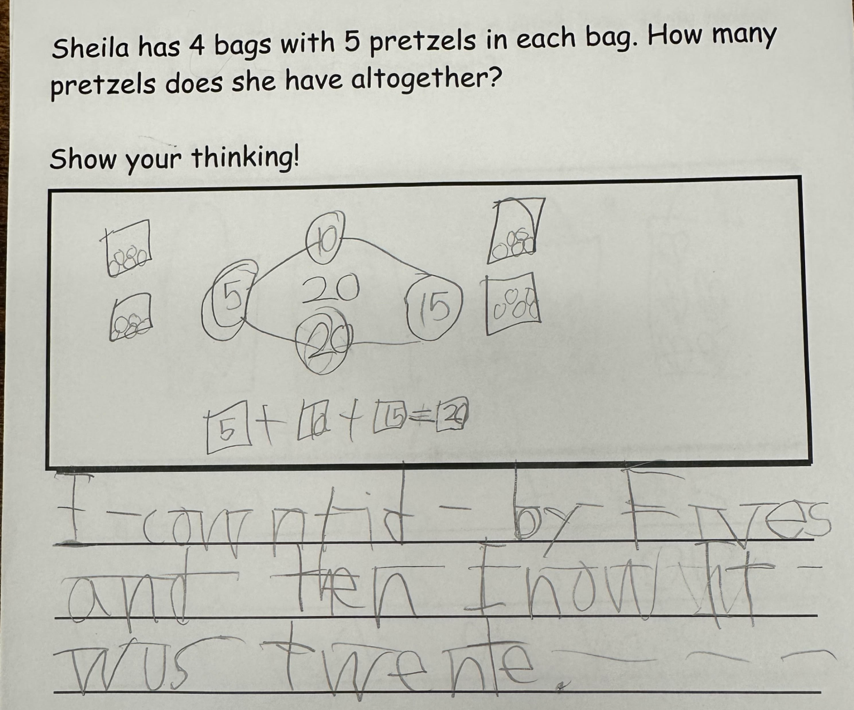
These simple questions prompted students to write down their thoughts. We wanted them to make a claim (write an answer in a sentence) and provide evidence to support their claim.
Notice how the student draws a picture of the bags with the pretzels and creates a number model showing how he counted by fives to get to the answer 20. While his equation needs some work, we can see that he’s attempting to write an equation that shows how he skip-counted by fives. The models helped him when we asked, “How did you solve the problem?” He was able to reference his models and explain in words what he did.
This student (see below) also made a claim, drew pictures, and used numbers and equations to support her claim.
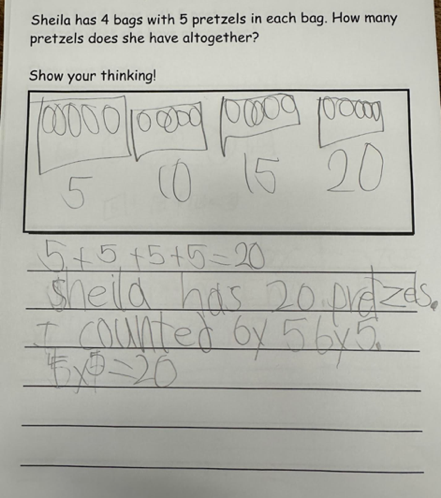
When we returned to the workroom, we poured over the student work samples, using the following questions as a guide as we examined the papers, looking for strengths.
- Did students state an answer?
- Did they show evidence?
- Did they use a combination of pictures, numbers, and words to explain their strategy?
- Could the reader understand how the student solved the problem?
- Did they use math words in their explanation?
The Third Class
For the third classroom, we decided to create a vocabulary chart to encourage the use of math words and as a spelling resource. Some of the words teachers included were added, counted, by fives, by tens, equals, and altogether.
We also decided to provide a sentence frame to help students write about their thinking:
First, I _______. Then, I ______. Finally, I _______.
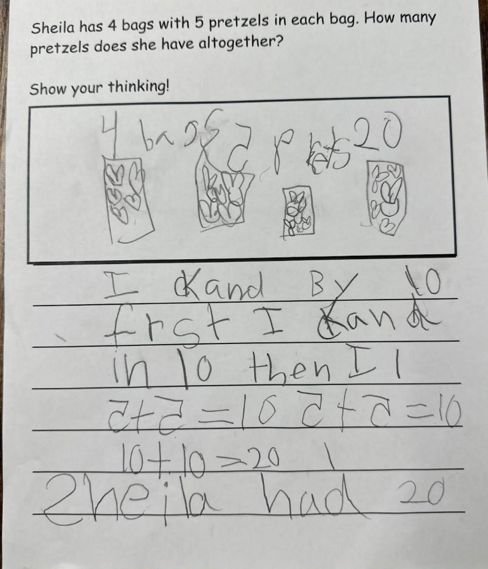
Each lesson was an improvement over the previous one. The supporting strategies we included each time showed up in students’ work. For example, notice how the student makes use of our sequencing frame to help her organize her writing.
“I counted by 10. First, I counted in 10, then I (did) 5+5=10, 5+5=10, 10+10=20.”
And there were surprises! See how this student uses multiplication to solve the problem.

Reflections and Next Steps
When we returned to the workroom at the end of the day, we reflected on what we’d learned, and the teachers planned for what next steps they’d take to support their students with writing in math class. Following are some of their insights and next steps:
- Creating models (drawings, equations) provide conversation pieces worth writing about.
- Vocabulary charts serve as a spelling resource and help students use math language in their writing.
- Sentence frames help students get started with their writing and organize their thoughts.
- Asking students questions like, “Can you draw a picture of the problem?” “How did you count?” or “What answer did you come up with?” prompts them to make a model, explain their thinking, and make a claim.
While the first-grade teachers were impressed by what their students could do, they were eager to continue providing the supporting strategies mentioned above. They also realized that students would benefit from engaging in interactive writing. In this strategy, the teacher works with the class to craft an explanation for a solution strategy. During interactive writing, the teacher can ask questions that prompt students to share ideas as the teacher models the writing process, thereby helping students think like expert writers. Questions like:
- How can we get started? Is there a picture and/or equation that models the problem?
- What would be a good sentence that describes the answer we got?
- What could we write that describes the drawings and equations we used to get the answer?
- Does what we wrote make sense?
- Let’s re-read what we wrote. Do we want to change or add anything?
The teachers also planned to share student exemplars with their class. These examples would include an answer stated in writing, models that represented the solution strategy, and the use of math vocabulary and would be clearly understandable. Students benefit from seeing strong models, and from responding to questions such as, “How does the writing in this piece of work help you understand how the student solved the problem?”
Final Thoughts
When students are expected to talk, write, and explain, they are no longer just following procedures. They are communicating what they think and how they solve problems. Writing in math class starts with expecting young children to communicate their reasoning, first with talk, then with models like drawing, and finally with the written word. Writing in math class forces students to express their reasoning clearly and precisely. This improves their ability to communicate complex ideas effectively (NCTM, 2024).
Thanks to the Vista first grade teachers whose openness, positivity, and thoughtfulness made our work with them so enjoyable. And thanks to their students who persevered, worked hard, and impressed us!