In the Classroom with Choral Counting

Rusty Bresser
What is Choral Counting?
Choral Counting is a routine that helps students notice patterns in our number system and develop their math discourse skills. Choral Counting can also support students’ understanding of counting concepts, place value, and the four operations including fractions and decimals (from Choral Counting & Counting Collections, Routledge Publishers, 2018). The routine can also engage students in important math practices such as constructing arguments and looking for patterns.
The authors of Choral Counting & Counting Collections offer some wonderful and innovative ways to lead counting exercises, making for a powerful math routine.
How It Works:
- The teacher chooses a starting number (starting from 1 or any other number), which number to count by (counting by 1s, 2s, 5s, 20s, 1/4s, 1/2s, and so on), and how she wants to organize the count.
- As the teacher and students count together, the teacher records the numbers in organized rows or columns of different quantities.
- As the teacher and students count together, the teacher pauses along the way asking students what they notice, to make predictions about an upcoming number, and so on.
- When the students have counted together far enough to get a good chunk of numbers on the board, the teacher again asks students what they notice and records their ideas, sometimes highlighting with a marker what students notice so that patterns are more visible to the class. The teacher might also ask students follow-up questions such as:
-
- “Is what you are noticing happening anywhere else?
- “What if we keep going? What do you think will happen?”
- “What number do you predict will be next?”
- “What is a number we would say in our count if we kept going?
- “What number would we never say in our count if we kept going?
Third Grade Teachers Investigate Choral Counting
Math Transformations’ Valentyna Banner recently spent a day with three third grade teachers in Vista, California studying choral counting. During the day, they planned the routine and tried it out in a few different classrooms. They were interested in the following questions:
- How can struggling students access the content through choral counting?
- How do teachers’ questions support students’ ability to recognize patterns?
- How can choral counting affect students’ fluency with multiplication?
- How can choral counting help students make the connection between skip-counting and multiplication?
As you read through the vignette, try to notice when there are connections to these questions.
Choral Counting in the Classroom
Valentyna begins the routine by telling the students that they’ll be counting together as a class, and that they’ll need to be good listeners and think like mathematicians. They’ll have to count together in one voice and not count too fast or too slow.
Jesus, one of the three third grade teachers on the team who is co-teaching with Valentyna, tells the students to turn to a partner and restate what their job will be today. This turn and talk gives students a chance to choose a partner that they’ll talk with during the routine as well as review what’s expected of them.
After students are finished, Valentyna tells the class that they’ll be counting by 4s and writes the number 4 on the chart paper at the front of the room. “If we count by fours, what number will come next? Quietly think, then turn to your partner and share your thinking.”
The room erupts in a buzz of chatter until Valentyna calls the class back to attention. She elicits several strategies students used to figure out that 8 comes next and writes them down for all to see.
She is especially happy that several students use multiplication.
Count on my fingers: Hold up four fingers then count 5, 6, 7, 8
Skip count: 4, 8
Add: 4 + 4
Multiply: 4 x 2
Next, Valentyna begins the count with the class, directing them to only count when Jesus points to each written number:
4
8
12
16
20
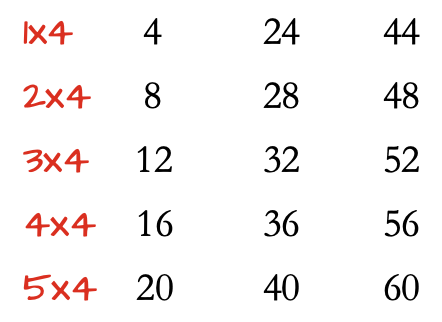
Valentyna stops the class after Jesus has made a column of five numbers, 4 to 20. During the planning session prior to going into the classroom, the third-grade teachers chose to organize the count vertically in columns rather than across in rows. Either way would work; however the patterns that emerge are different.
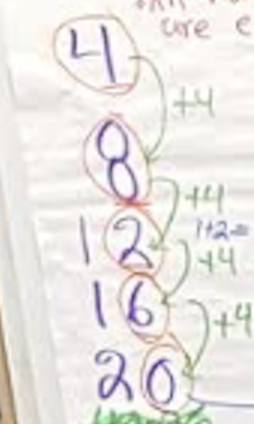 “What do you notice?” she asks. “Think for a few seconds, then turn and share what you notice with your partner.”
The room buzzes with talk as students share. Valentyna and Jesus circulate, listening in to what students have to say. Soon, Valentyna brings them back and elicits their ideas.
“I notice that you add four to each number, four plus four is eight and eight plus four is twelve all the way to twenty.” Jesus uses a marker and notes what the student has shared.
To make an explicit connection to multiplication and to rephrase what the student has said, Valentyna points to each number in the column saying, “One group of 4 is 4, two groups of 4 is 8, three groups of 4 is 12, four groups of 4 is 16, and five groups of 4 is 20.”
Another student notices that all the numbers in the one’s place are even numbers and explains how she knows they are even, “because you can count by 2’s and land on them.” Jesus circles the numbers in the one’s place.
Valentyna has the class continue the choral count, this time creating another column up to 40. Again, students notice the even numbers in the one’s column. Before moving on to the next column, she leads the class in counting from 4 to 40.
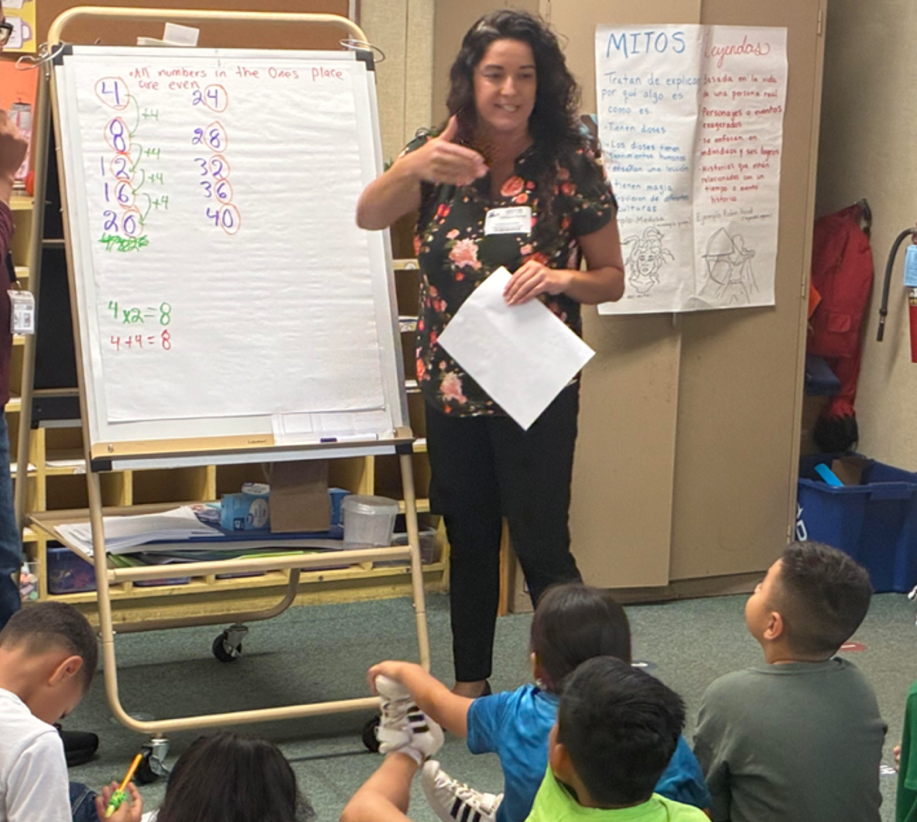
Noticing More Patterns
The count continues all the way to 60.
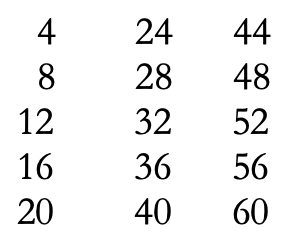
Up until now, students have noticed only patterns in the columns. To shift their attention, Valentyna prompts, “you might notice patterns going across.” She gives the class think time, then has them turn to a partner and share. The students’ conversations are focused and animated. They seem genuinely curious and excited to share the patterns they notice.
One teacher has partnered with one of her students who often struggles with math and notices how engaged the child is. Later, the teacher will report that today was one of the few times this student has contributed to math discussions.
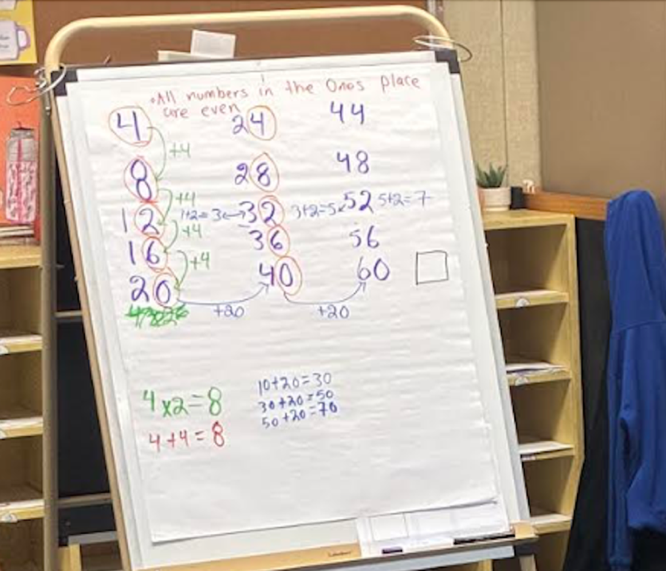 When the room quiets down, Valentyna elicits ideas. Students see that the numbers in the rows increase by 20 (see the chart). Jesus uses a marker to note this observation: 20 + 20=40; 40 + 20 = 60.
Valentyna has the class pause here and draws a box next to the 60 (see chart). “What number would go here? Can you make a prediction based on the pattern we just observed?” This question prompts students to engage in an important math practice, where young children look closely to discern a pattern or structure to be able to make predictions, readying them for future algebraic thinking.
After a brief partner talk, Valentyna asks the class to whisper the answer (80) and then has a student explain.
“The number will be 80 because we are adding 20 each time. 20, 40, 60, 80.”
“Do you think if we keep counting by 4’s we’d land on 120?” Valentyna’s query invites the students to extend the pattern that they’ve noticed.
“Yes,” says a student. If I keep counting on by twenties, I’ll land on 120. Like 80, 100, 120.”
“Do you agree?” Lots of students nod or show their ‘me too’ signal.
Valentyna and Jesus recognize that 15 minutes is about the limit to the choral counting routine and end by thanking the class for their hard work.
The Teachers’ Takeaways
At the end of the day, after investigating choral counting in three different classrooms, the teachers reflected with Valentyna. How did the routine go? What did they learn about the research questions they were curious about?
Overall, the teachers felt more comfortable with teaching the routine in their own classrooms. They noticed that the students they observed were all capable and had access to the content. They also realized that they could teach so much more in one short routine than they could teaching several lessons from their teaching guide.
While the third-grade teachers saw many connections to their questions in the routine, it would take many more choral counting experiences to see the full benefits to students, especially since this was their first time with the routine.
-
Were there (or will there be) opportunities for students to make connections to multiplication? Absolutely, since choral counting involves counting multiples of a given number. Looking forward, the classroom teacher could revisit the chart and add notations to make the connections to multiplication even more explicit:
- Did the teachers’ questions help students recognize patterns? Yes. In fact, questions such as, “What number do you predict will come next?” serve to focus students’ attention on patterns and structure.
- Can the routine strengthen students’ skip counting skills and therefore support the transition from additive to multiplicative thinking? Yes! In fact, students during the lesson not only practiced skip-counting repeatedly, but they also got the chance to think about and perhaps learn new strategies that focus on addition and multiplication.
- Did choral counting support students who struggle with mathematics? It seemed to. The teacher who partnered with one of her students saw a new sense of engagement she hadn’t seen before, and engagement is an important first step in accessing the content. More experience with choral counting would be necessary to see its effect on struggling students.
Final Thoughts
We conclude this post with a quote from the authors of Choral Counting & Counting Collections (Franke, Kazemi, & Turrou, 2018) and thank them for providing teachers with an invaluable resource.
“Counting is fundamental to learning mathematics in elementary school. It supports the development of a deep understanding of numbers, providing the core foundation for understanding place value, how numbers are composed and decomposed, and how they are related to one another. This deep understanding of numbers allows students to operate on them in powerful ways.”