Three Books about Birthdays that Lead to Some Terrific Math Questions

Rusty Bresser
Why use children’s literature in math class? This isn’t a new question, and I’m glad that teachers have come to see the value in reading a story to either launch or summarize a math lesson. There are so many benefits! Literature provides real-world contexts for using mathematics, and stories can be engaging and motivating, bringing meaning to numbers, shapes, and data. Plus, children love to be read to!
When choosing children’s literature, I vet them by looking for interesting settings, unforgettable characters, relatable situations, colorful language, eye-catching illustrations, and important messages from the author. For me, books don’t necessarily need to have math in them or scream, “Use me for math!” In fact, some of the most interesting stories that launch a math lesson might not have any explicit connection to mathematics.
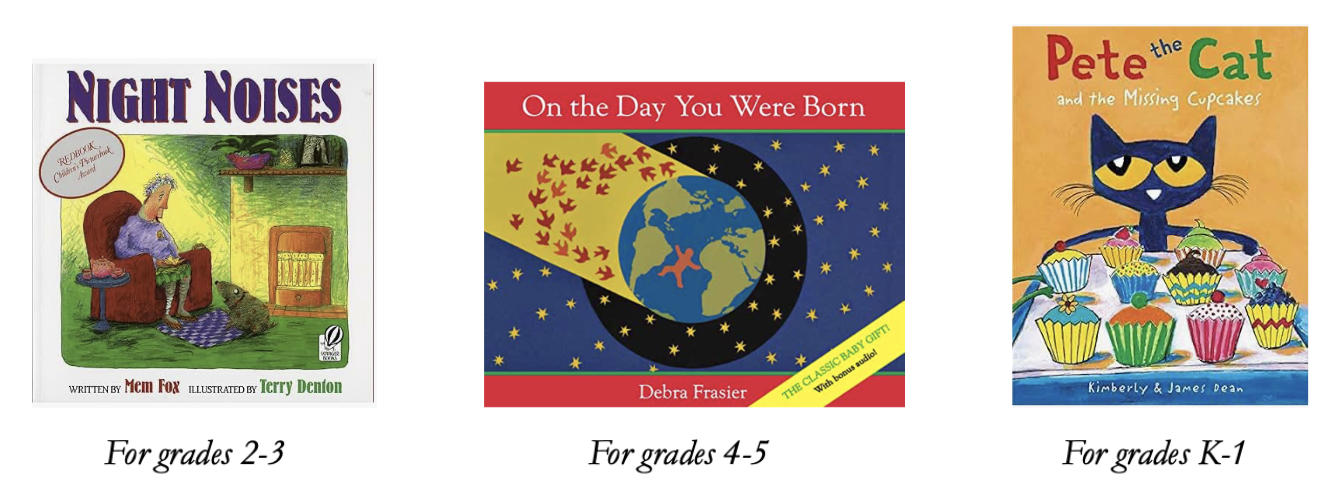
Night Noises: A Birthday Story for Second and Third Graders
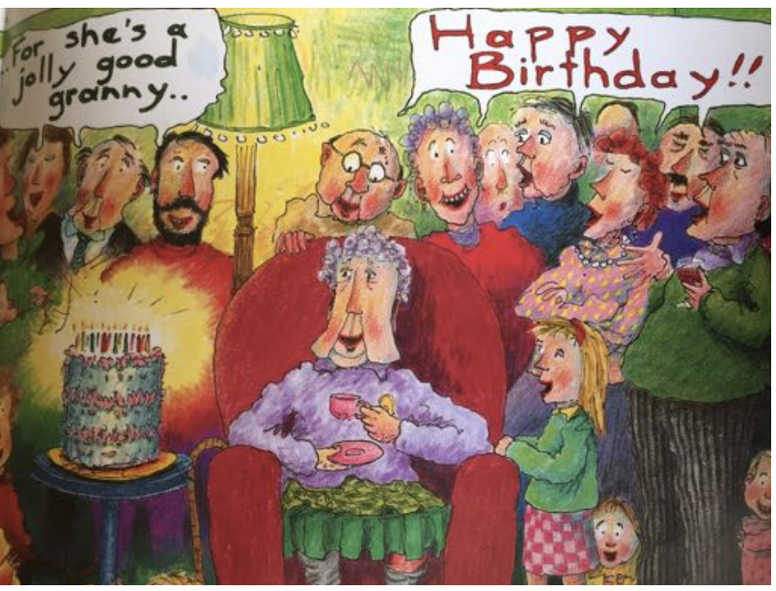 Mem Fox is one of my favorite children’s book authors, and Night Noises is, in my opinion, one of her best. It’s a story about 90-year-old Lily Laceby and her loyal old dog Butch Aggie. On a wild winter night, Lily falls asleep by the fire, dreaming of her youth, while Butch Aggie hears mysterious noises outside. Finally, a startled Lily is awakened, opens the door, and is surprised by her family who’ve come to celebrate her birthday!
Lily’s big family files into her house, including her 2 sons, 3 daughters, 14 grandchildren, 35 great-grandchildren, 1 great-great grandchild, and 47 friends, which begs the question, “How many came to Lily’s birthday party?”
After posing the question, ask students to talk with a partner about how they would go about solving the problem. What math would they use? What math tools might they need? How will they get started? You might even ask students to estimate first.
Following are some examples from a second-grade class. Notice how this student uses an open number line to solve the problem. 
This next student (see below) arrives at an incorrect answer (just one off because they forgot to add Lily’s great-great grandchild) but shows an understanding of place value by adding all the single digits together, then the tens together, before combining them all. Pretty creative!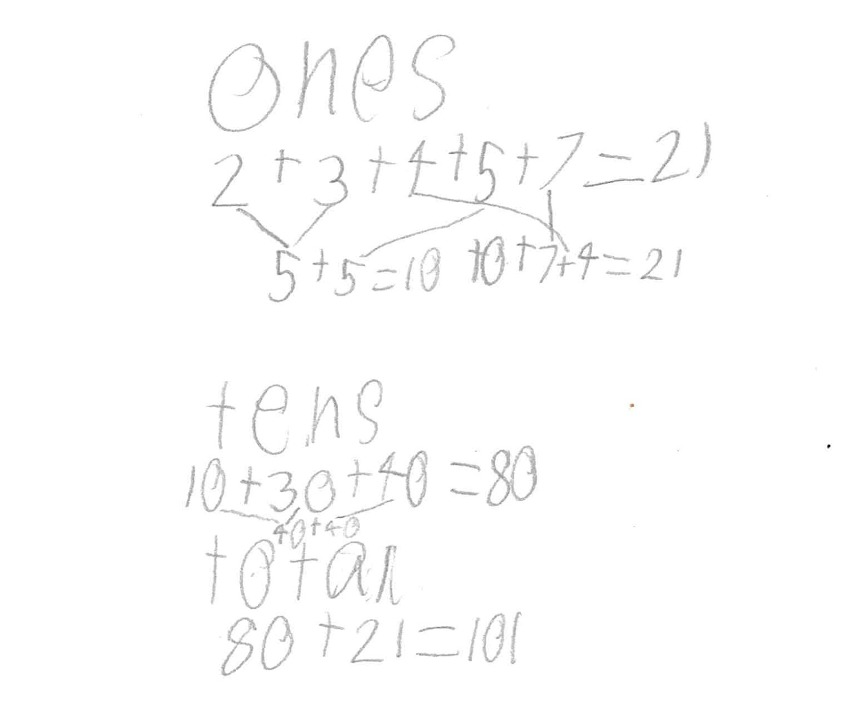 Asking students to figure the total number of birthday guests is one way to use Night Noises as a springboard for doing math. Another way is to tell your students that Lily has 95 party hats and then pose the question, “Does she have enough hats so that each guest can wear one?” This question creates a two-step problem where students must first figure the total number of guests, then compare that with the 95 hats and find the difference.
On The Day You Were Born: A Birthday Story for Fourth and Fifth Graders
This book by Debra Frasier (1991) celebrates life by listing forces in the natural world, “each ready to greet you the very first moment of the very first day you arrived.” Colorful wood-block prints accompany a gentle text that describes migrating animals, the spinning Earth, the pulling gravity, the flaming Sun, the rising tide, and more— each of which was doing something “on the day you were born.” It’s really a book about science and nature, which leads to the question, “How many days have passed since you were born?”
Before you continue reading, think about how many days you’ve been alive. Estimate the number and see where your thinking takes you. Do not use pencil and paper—use only mental math.
What did you notice about how you estimated? Did you round to friendly numbers? Did you have to do some computational estimation to arrive at your estimate? What are all the things you had to consider when making an estimate? I love this question because even while estimating, we must engage in problem solving. How many days are in one year? How many years old am I? How many days have passed since my last birthday? What operation(s) must I use? All these decisions are important, and it’s crucial that we allow students to make them because when they do, they improve their number sense and problem-solving skills.
If you think students need some scaffolding to make their estimates, consider showing them the following possible estimates and have them choose one that’s reasonable and explain why. Then have them account for why they didn’t choose the other estimates.
- About 40 days
- About 400 days
- About 4000 days
- About 40,000 days
Notice how students’ reason about the estimates. Do they have a sense of reasonableness? For example, do they say things like, “Four hundred can’t be right because it’s a little over the number of days in only one year.” Or do they reason that “360 times 10 is about 3000, so it can’t be 40,000.”
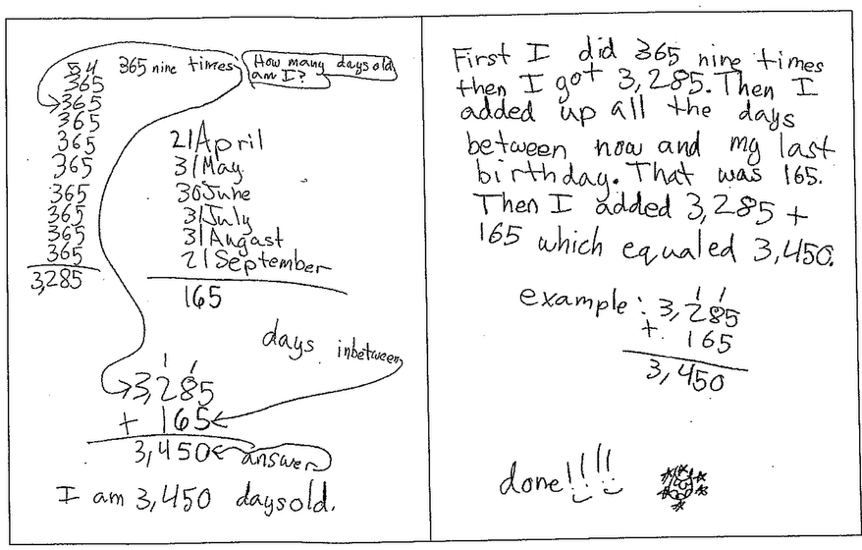
Giving students a chance to estimate helps them think about whether the answers they ultimately arrive at are ‘in the ballpark’. Once students make estimates, have them figure exactly how many days have passed since they were born. Below are a few examples from fourth graders. Notice how this student (see below) explains their reasoning step-by-step:
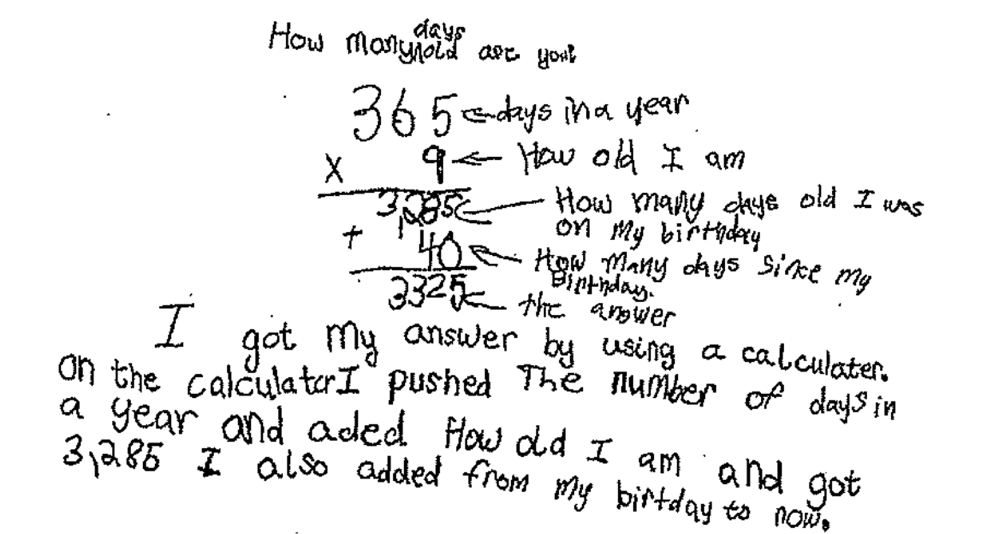
This student uses labels to bring meaning to the numbers:
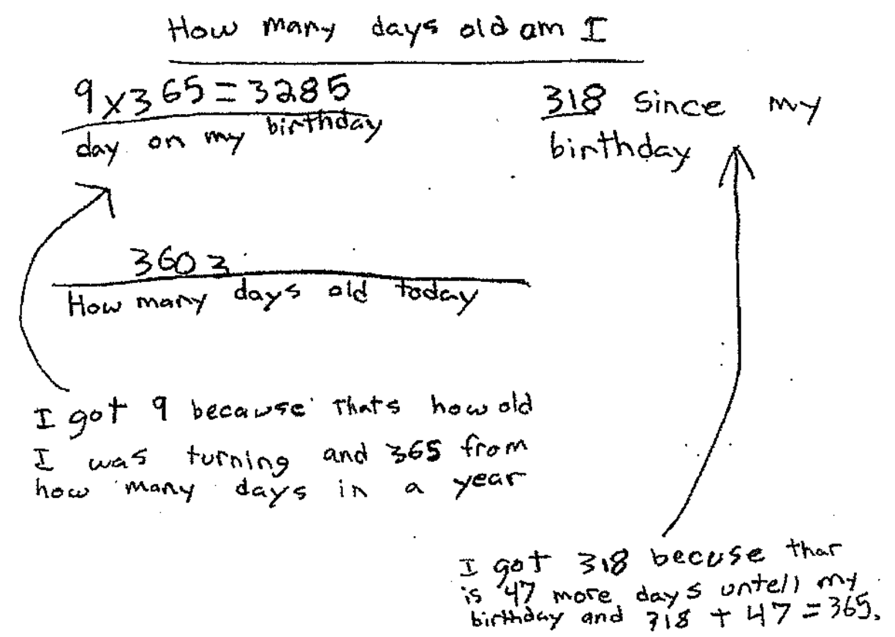
 And notice how this student’s work is organized and easy to follow:
Pete the Cat and the Missing Cupcakes: A Birthday Story for K-1 Students
In this book by Kimberly and James Dean (2016), Pete and his friend Gus bake 10 cupcakes for a birthday party. However, the cupcakes mysteriously keep disappearing in pairs. The story follows Pete and Gus’ efforts to figure out who ate the missing cupcakes!
The book provides the perfect context for playing the How Many Are Missing? game with K-1 students. This is how it works. The teacher puts some cubes (cupcakes) on a plate. She then hides some of the ‘cupcakes’, leaving some of the leftover ‘cupcakes’ on the plate. Students must figure out how many are missing.
Example Scenario:
- The teacher places five ‘cupcakes’ on a plate.
- She verifies with the student(s) how many ‘cupcakes’ are on the plate.
- The teacher hides three ‘cupcakes’ and asks, “How many are missing?”
- Student(s) respond, and then the teacher reveals how many ‘cupcakes’ are missing.
- The teacher continues with the activity, hiding different amounts each time. To move onto the next number of ‘cupcakes’, a student must be fluent with the number they’re working with. In other words, they can’t move on to six until they’ve mastered ways to decompose five.
I love this activity because students are working with the number of ‘cupcakes’ at their level (or just beyond). For example, if a student can decompose numbers through 4 by memory, then they are ready to play How Many Are Missing? with five ‘cupcakes’.
I also like the game because it helps students learn how to decompose numbers into their component parts (4+1; 1+4; 2+2; 3+1; 1+3) while helping them commit math facts to memory. A teacher might use the activity as an assessment, gauging what number facts a child should be working on during math time.
Literature Brings Math to Life
When we read literature to children, we provide contexts (like birthdays!) that can pique their interest and motivate them to solve problems or answer questions that grow from ideas in a story. Stories can give meaning to numbers, giving purpose to problem solving, igniting curiosity and interest.
We hope you’ll try out some of the ideas that we’ve shared in this post, and we encourage you to use literature as a way into mathematics for your students.