The Sticker Math Game: Developing and Using Place Value in First and Second Grade

Rusty Bresser
Do you remember your teacher in grade school telling you to “always start adding in the one’s place”? It seemed like a rule that you had to follow, whether it made sense to you or not. It turns out that when children are given the opportunity to solve problems in ways that make sense to them, they often don’t start in the one’s place, they start adding (or subtracting) from left to right, starting with the largest place value (the “front end”) rather than the traditional right-to-left method. Using this “front end addition” makes sense because it simplifies calculation by breaking numbers into expanded forms (e.g., hundreds, then tens, then ones) to avoid carrying.
Whether students add or subtract the tens first or the ones first, it’s important they understand that the two digits of a two-digit number represent amounts of tens and ones, and for second graders, they also must use place value understanding to add and subtract (Common Core Math Standards, 2013).
In this post, we’ll go into a second-grade classroom to see how students use The Sticker Math Game (an adaptation of the Sticker Compare game from Investigations) to develop, use, and reinforce their understanding of place value. In her blog post, Christina Tondevold says that “Kids need to have experiences that build their number sense, that build their place value, and then they will use those experiences when they are solving problems.” The Sticker Math Game is one of those experiences that build number sense and place value.
Directions for the Game
Materials: Deck of sticker cards (use this sticker card link) and a Student Record Sheet
- Partners shuffle the deck of cards and place them face down.
- They take turns turning over one card from the deck.
- After turning over their card, a player figures the total number of stars on their card, and explains their reasoning.
- Players figure the total number of stars on both cards.
- Players figure out how many more stars one card has than the other.
In the Classroom with Second Graders
To try out The Sticker Math Game, I visited my friend Lila’s classroom. Lila has a diverse group of second and third graders, and it’s always a pleasure to work with her students and observe her teaching.
Lila begins by sharing the following visual image with her students. She asks them, “What do you notice?” and gives them time to think. Asking open-ended questions like this casts a wide net, often eliciting a range of responses from students, revealing what they know and understand.

After students briefly share their thinking with a partner, Lila elicits ideas from a variety of students. Each time a student comments, Lila asks them to explain their thinking.
Students notice and count groups of ten stickers and extras. Most figure the total number of stars by combining tens first, then the extra ones. One student compares the images, explaining that “One side has ten more because twenty-three plus ten is thirty-three.” This visual image routine seems like the perfect way to get the students ready for playing The Sticker Math Game.
Students in the Spotlight
After explaining the The Sticker Math Game to Lila’s second graders, I circulate and observe, asking questions, such as…
- How many stickers do you have? How do you know?
- Write that number. What does this digit mean (as I point to each digit in the number)? Show me in the stickers.
- How many stickers do you both have altogether? How do you know?
- Who has more stickers? How do you know?
- If you had to find out exactly how many more, what would you do?
I’m curious to see how students will make sense of the quantities on the cards. Will they count by ones? Tens? Do they understand and apply place value? What strategies will they use when combining and comparing quantities?
The following students are ones I spent more time with, and they represent the range of student thinking among the second-grade group.
Rob and Brighton
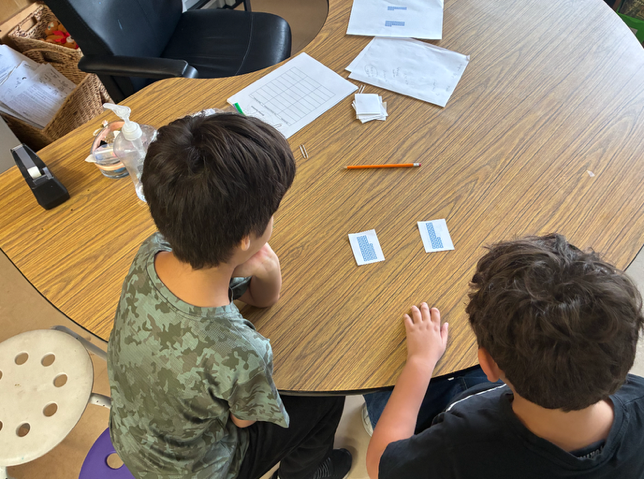
The boys have just put the following cards on their table when I stop to observe.
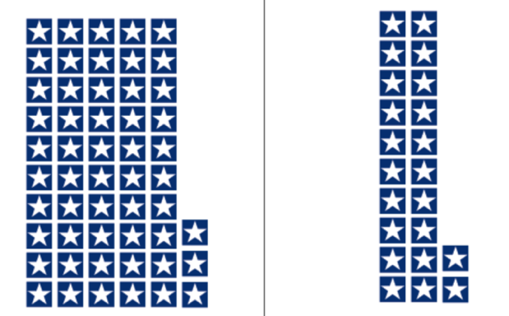
“How many stickers do you have?” I ask Rob.
“Forty-three!” he quickly responds.
“How did you figure that out so fast?” I ask.
“I counted by tens and then added the three extras.”
“Brighton, how about you?”
Skipping over my question, Brighton asserts, “Rob has about thirty more stars than me. See?” He points to the groups of tens to explain, disregarding the extra stars. Personalities really emerge when kids do math!
“If we add all of the stars together, how many would that be?” I ask. This time I give them time to think. After a minute or so, Rob explains his thinking.
“There’s seventy-five stars. I did seven times ten, plus the five extras.” I’m surprised because I hadn’t expected the second graders to apply multiplication. I love these kinds of surprises.
Brighton goes next and explains how he added the tens then the ones.
For my final question I ask the boys how many more stars Rob has than Brighton. Comparing quantities was a harder question, but these two work together to figure it out.
“Rob has more,” says Brighton. “I add three tens and one more to my stickers to make it the same as Rob’s. Rob has thirty-one more than me.”
I’m not surprised by their response. Just as students will often start adding from left to right, they’ll also use addition to solve subtraction or compare problems.
Reflecting on Rob and Brighton
There are so many things I like about this game. First, it provides students with opportunities to see the quantities they are working with. The game also sets up contexts for combining quantities in different ways, revealing students’ strengths, like Rob’s ability to use multiplication to make things easier. The game also sets up subtraction opportunities as students compare the numbers on their cards: who has more and how many more?
Leslie and Lilia
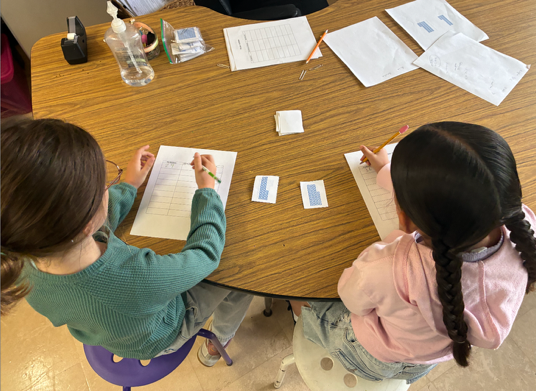
When I visit Leslie and Lilia, they’d already been playing the game for a while, so I jumped to the question, “How many stars altogether?” Here are the cards they had placed on their table:
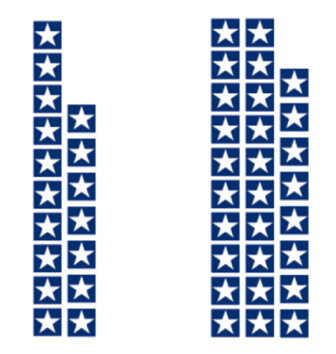
As Leslie explains, I record her thinking on a piece of paper:
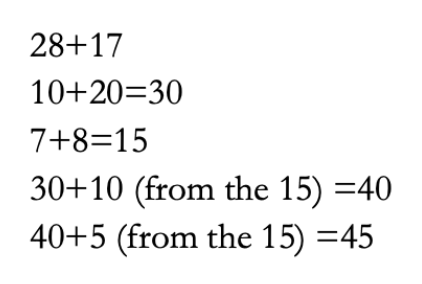
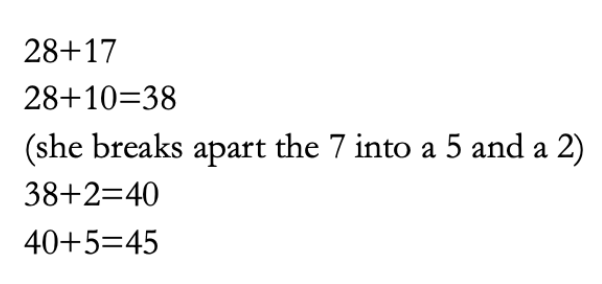
Lilia goes next. Again, I record her thinking on paper:
Reflecting on Leslie and Lilia
Without exception, students added from left to right, always combining the groups of ten first. And when combining the extras, Leslie created another ten from the 15 extras to add to the thirty. She was regrouping the ones into a ten. Although Leslie probably didn’t need the visual support, other second graders might benefit from seeing the quantities they are combining. This is one of the aspects that I love about this game; it provides the kind of support that allows all second graders (and first graders) access.
Lilia demonstrated her ability to add ten to two-digit numbers (28+10=38). She also shows that she can break numbers apart (7=5+2) to create another multiple of ten (38+2=40).
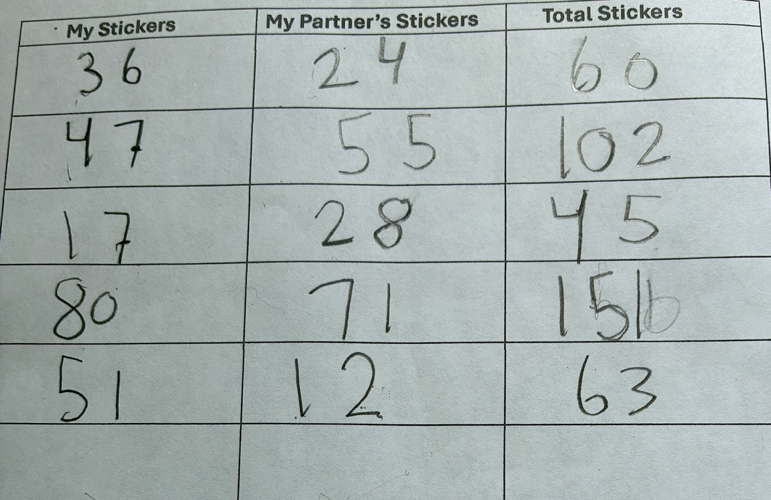
Here’s a copy of Leslie and Lilia’s recording sheet they and other students used to document their games.
Using and Applying Place Value
To add and subtract effectively and efficiently, students must understand that the two digits of a two-digit number represent amounts of tens and ones, and for second graders, they also must use place value understanding to add and subtract (Common Core Math Standards, 2013).
The Sticker Math Game supports place value understanding and application by providing students with visuals that are organized into tens and ones. And the game is fun! The second graders in Lila’s class were motivated and excited as they counted, combined, and compared their star stickers in ways that made sense to them. We hope you try it out with your students!
Thank you Lila and your students for helping us learn more about children’s thinking!