Unpacking Pygmalion: Changing How We Perceive and Talk About Our Students

Rusty Bresser
Recently, a colleague and I were working with a group of first graders engaged in Choral Counting. At the break, we were reflecting on the lesson with the classroom teacher. I listened as my colleague described how two students figured out how many objects were in their baggie. One of the first graders had organized the objects into groups of ten and extras, efficiently figuring the total, while another grouped them into different amounts, struggling to find the answer.
The classroom teacher responded, “Oh, yes, I expected Jason to find an efficient way, he’s one of my high kids.”
“Oh, actually, it was Amanda who quickly figured the total, not Jason.”
The classroom teacher couldn’t believe it. “Really?” she said. “Amanda’s one of my low kids. I’m shocked!”
We Categorize to Make Sense
Teachers are good citizens, and our intentions are good when we talk about the ‘low kids’ and the ‘high kids’ in our classes. Just as humans categorize things to simplify an overwhelmingly complex world, teachers also use categories like ‘high’ and ‘low’ to make sense of a complex classroom full of students with a vast range of differences, challenges, and needs. Teaching is hard!
In our efforts to meet students’ needs, we often put them into more easily managed boxes because it allows us to target instruction and simplify lesson planning. But, putting students into these boxes can have unintended consequences.
The Power of the Pygmalion Effect
There’s a famous Greek myth about the sculptor Pygmalion who created a statue so beautiful that he fell in love with it. He treated the statue as if it were alive, and the goddess Aphrodite honored his wish, bringing it to life. This symbolizes that intense belief can make a potential reality. The ‘Pygmalion Effect’ finds its way into the classroom when teachers hold high or low expectations of their students, thereby treating them differently (Center for American Progress, 2014).
Children do better when more is expected of them, and they do worse when we expect less. It seems obvious, doesn’t it? And maybe it is. This effect has been supported by study after study, but it hasn’t stopped us (including me) from unintentionally giving in to our biases. The ‘low kids’ often know they are perceived that way, and the ‘high kids’ do too.
What’s a teacher to do?
The more we talk about a child as ‘low’ or ‘high’, it’s likely that this label will set in like cement in our minds. But how do we break the habit? I love the following quote from William H. Johnson, Superintendent at Rockville Centre School District because it inspires me to change how I perceive children’s math abilities. He says, “I truly believe that it is my job not to discover limits of what a child can do but actually give them ways of breaking through those limits (Education Week, June 1, 2016).”
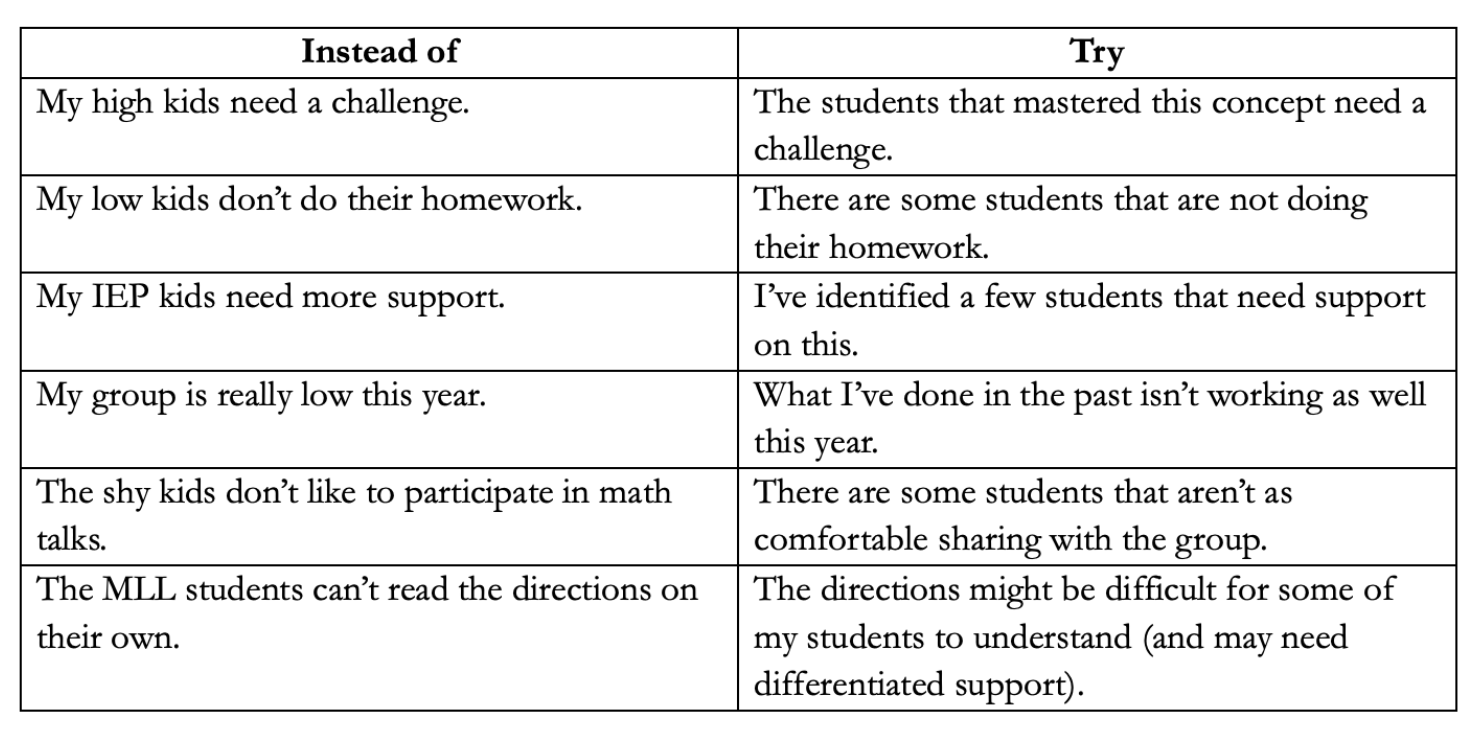
In her blog post (May 3, 2018), Annie Forest challenges us to “use that kind teacher heart of ours as a lens to examine what short cuts our brains have made for us.” She’s talking about referring to our students as the ‘highs’ and the ‘lows.’ Forest shares some sage advice, giving us alternative ways to refer to or think about students.
I love Forest’s suggestions because they help us talk about our students in ways that more accurately express their needs rather than referring to them according to a label. Her advice doesn’t skirt the fact that some students DO need extra support, differentiated tasks, or further challenges. Some of her ideas shift the focus from the student to how the teacher might provide support.
See Students through an Asset-Based Lens
Another way we can reshape how we perceive students’ math abilities is to examine their work through an asset-based lens, looking for what they CAN do and what they DO seem to understand before shifting to what they need help with.
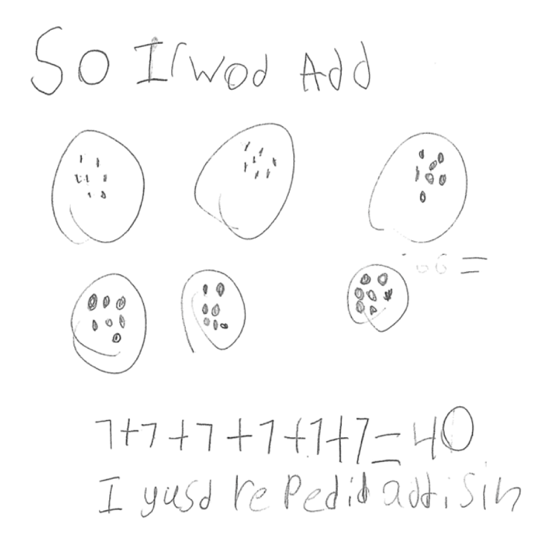
For example, in a recent post we looked at how different students figured out how many dinners Sid the cat ate in one week if he eats six dinners a day. Some students applied multiplication, thinking of the problem as seven groups of six. Others used repeated addition, adding six seven times. Even for students who struggle, we can look for and appreciate their strengths first and then guide them to their next steps. We can see that this student’s answer is off, but he’s close (see the image), and their representation of the problem is six groups of seven rather than seven groups of six. But they can represent the problem using a set model and an equation, and they let us know in writing that they used repeated addition. This isn’t a ‘low’ student; they are just on their own learning trajectory, just like everyone else.
Use Flexible Groupings
When we place students that we perceive as ‘low’ into homogeneous, rigid, and unchanging math groups, we are sending a message that can affect how these students see themselves as mathematicians. When I was in elementary school, I was labeled an ‘average learner’, so for six years I was consistently put in the average math and reading groups. The label was set in stone, passed along from one teacher to the next, ensuring that my learning experiences were limited to engaging with students at ‘my level’.
Sometimes, it’s beneficial for students and easier for the teacher to pull small groups consisting of students at the same or similar skill level. For example, maybe there’s a group of first graders who are working on learning their basic addition facts to five, whereas the other students in the class have moved on to facts through ten. Or a fifth-grade teacher might work with a small group of students who still need decimal grids to help them conceptualize decimal numbers. These ‘flex groups’ aren’t permanent and can disband or regroup at any time.
Students also benefit from working with a variety of learners. Math Workshop is a way to structure math time so that students have choices (see our post on Math Workshop here). During Math Workshop, students might have anywhere from three to six different activities from which to choose. They get to choose the activity, they get to choose whether they work alone or with a partner, and they get to choose how long they want to work on a task and where they want to work. In this setting, all students are more likely to be perceived as being able to join in and do the math.
Whether students are working in flex groups, in a Math Workshop, or working in a whole class setting, it’s important to keep in mind that there are different reasons for grouping kids during math time and that students benefit from working with a variety of learners.
Offer Low-Floor/High Ceiling Tasks
Rather than thinking that the ‘low kids’ need math tasks that are completely different from the ‘high kids’, consider offering tasks that have a low-floor and a high ceiling. For example, look at the following open-ended problem: Find different ways 10 turtles and be on the log and in the pond.
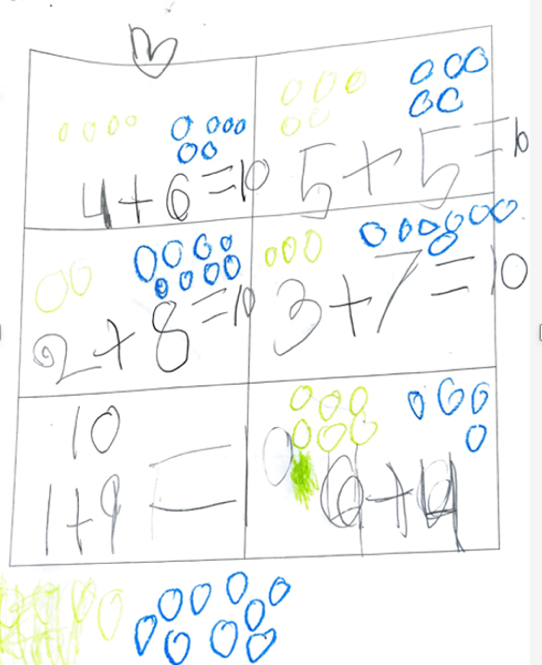
This kindergartner found several different ways that 10 turtles could be on the log and in the pond. Other students found fewer ways; some found more. Some used equations; others used pictures. The task was wide enough to accommodate a range of learners, while everyone got the chance to engage in the same content.
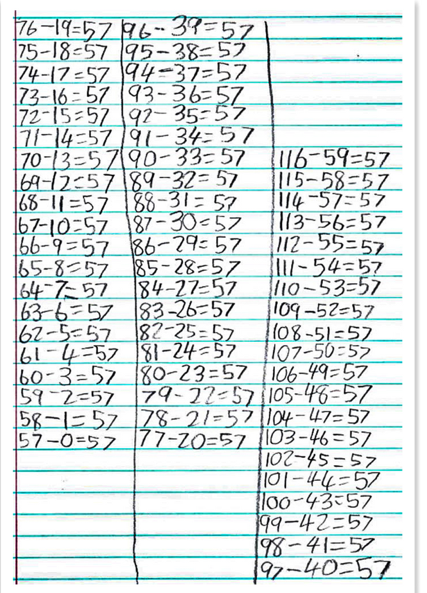
Here’s another example of an open-ended, low-floor/high-ceiling question: The answer is 57, what could the question be? This student’s response (see below) was a surprise! Is he a ‘low’ or ‘high’ student? Does it matter? What matters is what we can learn about this student’s math thinking (and then help him move forward). For example, how does he use structure and patterns to explore the questions that come from ‘the answer is 57’.
Changing the Ways We Perceive and Talk about Our Students
Nowadays, whenever I catch myself placing a student in a box labeled ‘high’ or ‘low’ (which I do!), I pause and try to find another way to describe them or see them. It’s hard to undo what you’re used to doing. Nigerian writer Chimamanda Ngozi Adichie talks about the ‘danger of a single story’. Her message is about the limitations of putting people into boxes, relying on a single, limited narrative to understand them.
The same can be said about the classroom. When we place students into ‘high’ and ‘low’ boxes, it can influence how we see them (and how they see themselves), talk about them, the expectations we have for them, and the support that we provide. As I continue to work with students and learn more about them, I’m going to use that kind teacher heart as a lens to examine what limiting shortcuts our brains have made for us and think more broadly about what it means to be smart at math.