Writing Multiplication and Division Word Problems

Rusty Bresser
Why pose ready-made word problems for students to solve when they can create and then solve ones themselves? Having students create their own math word problems shifts them from passive calculators to active mathematical thinkers. Creating word problems helps students understand the story structure, boosts engagement and personalization, and strengthens mathematical reasoning.
In this post, we’ll explore a four-part lesson that not only gives students experience writing and then solving multiplication and division word problems but also helps them understand the meaning of and the relationship between the two operations. It’s one of those low-floor, high ceiling lesson sequences that’s engaging, covers several important standards, and provides the right amount of support (especially for multilingual students) while allowing for the right amount of cognitive demand. We hope you try it out!
Part 1: Things That Come in Groups
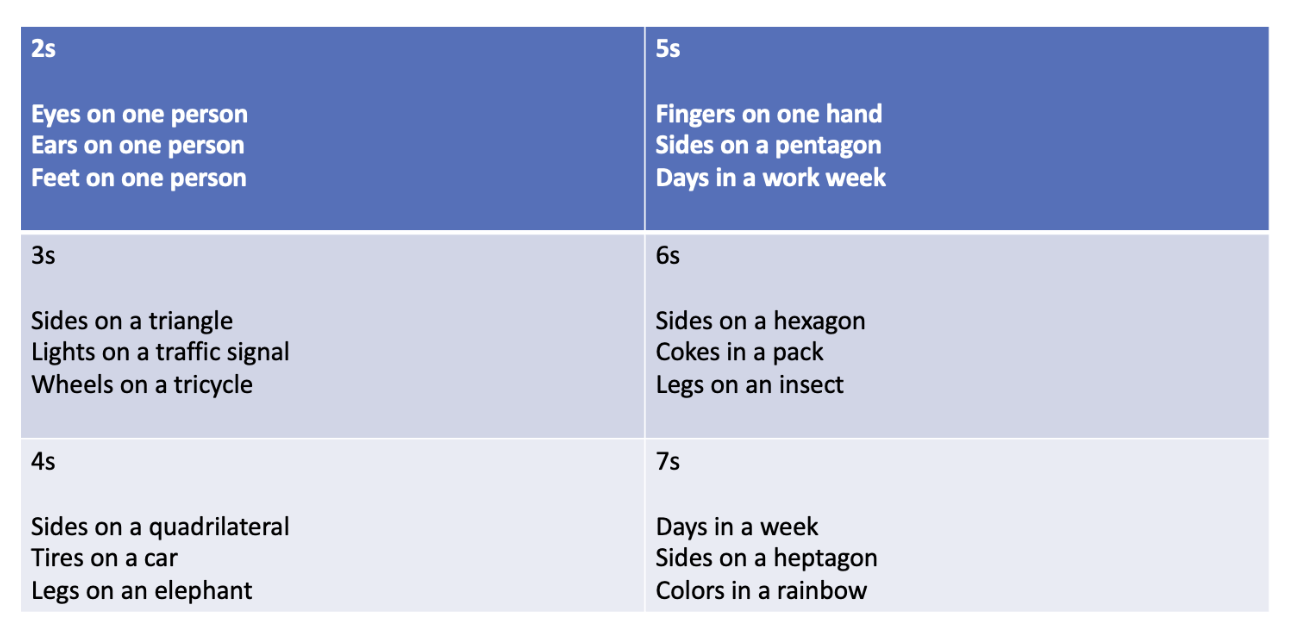
Begin by showing students examples of realia or photos of things that come in equal groups of 2, 3, 4, 5, 6, 7, and 8 (you can go all the way to 12 if students are ready). For example, gloves come in groups of 2, triangles have 3 sides, and cars have 4 wheels.

Next, brainstorm with the class things that come in groups, recording ideas on a class chart like the example below. You can keep adding to the chart, assigning it for homework so families can help. The list is important because it provides the ideas students will use when writing their stories.
Part 2: Writing Multiplication Stories
Once the Things That Come in Groups chart is complete, model for the class how to write a multiplication story using the following steps:
- Choose a number from the chart (e.g. 4).
- Choose an item from the list (e.g. car wheels).
- Think of how many of the items will be in the story (e.g. 5 cars).
- Write a story using the sentence frames.
- Draw a picture of your story and an equation to represent it.
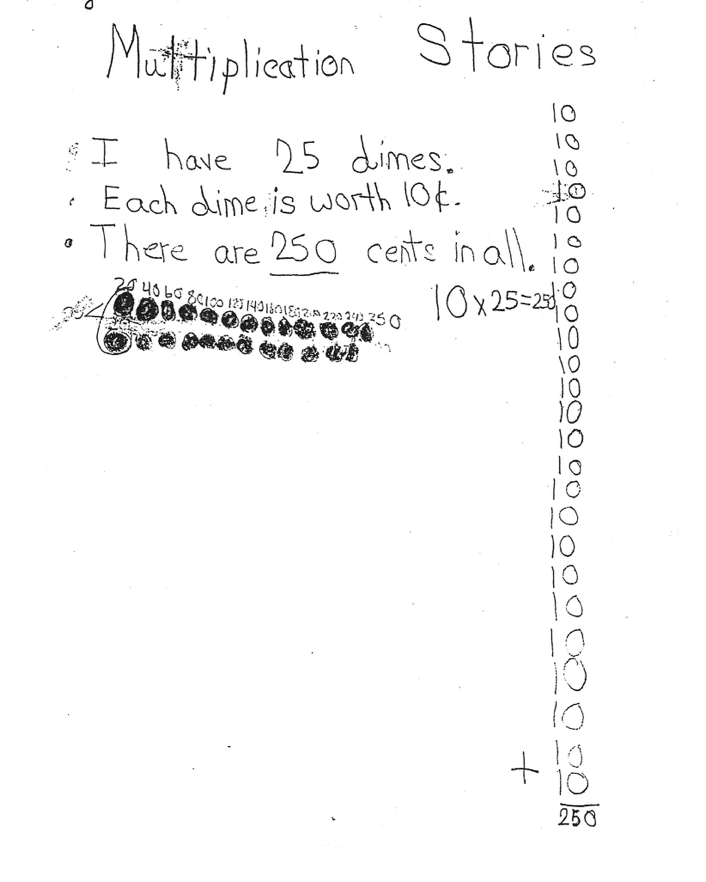
 Writing multiplication stories helps both second and third graders gain foundations for multiplication, providing them with real world contexts that support concept development. For example, this student (see below) uses money as a context for their story and includes an equation to match!
Teachers can facilitate concept development by asking students, “What do the numbers (factors and product) mean in your equation?” The nice thing about the story is that it spells out what the numbers mean, helping students answer the question.
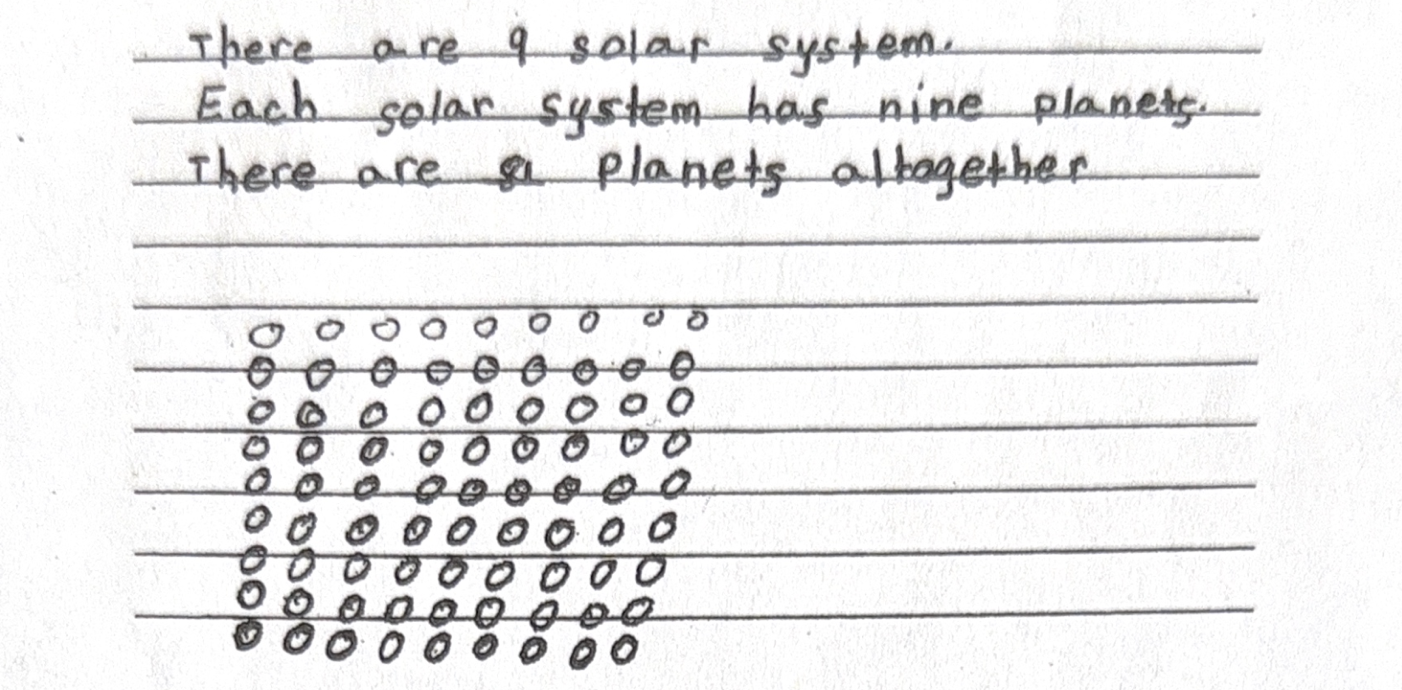
This student (see below) uses an array to show nine solar systems with nine planets in each:
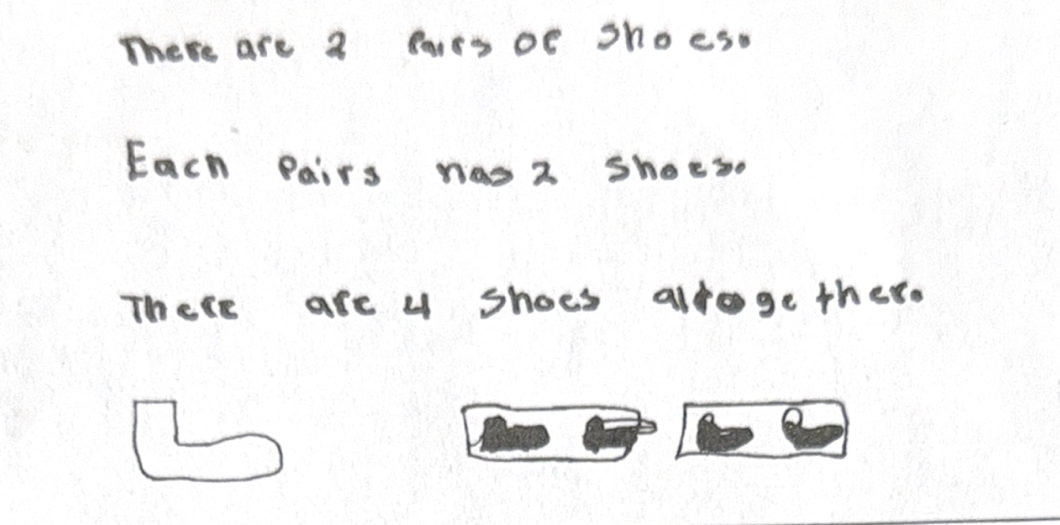
This student uses pairs of shoes as a context:
Part 3: Turning the Multiplication Story into a Problem
To explain how to turn a multiplication story into a word problem, show the original story you modeled, covering up the last number in the story (20 wheels) with a 4-by-4 piece of construction paper. Ask the students if they see where the “unknown” is.

Tell the students that to turn their story into a math problem, they must make the last sentence a question, like this:
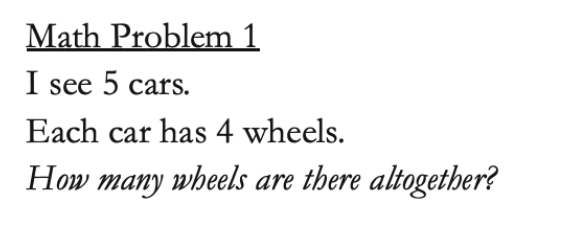
After modeling, direct students to turn the last sentence in their story into a question.
Writing Math Problems 2 and 3
For Math Problem 2, show the class the original story and ask, “What other numbers can we make unknown?”
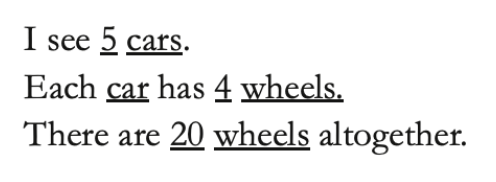
If they say ‘4,’ cover up the 4 with the 4-by-4 piece of construction paper like this:
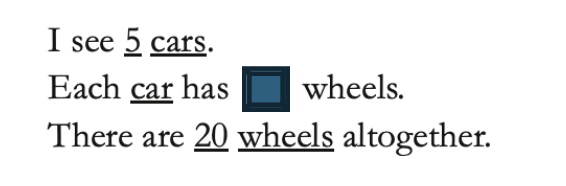
Now show them how to rewrite the story to create Math Problem 2.
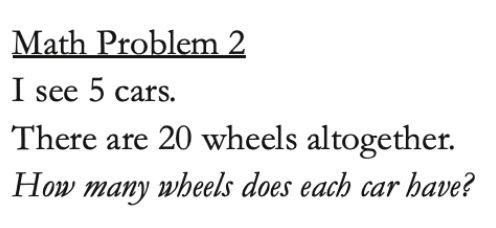
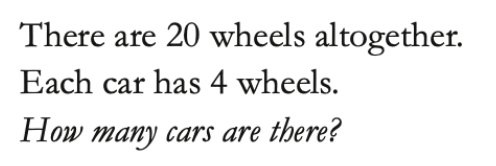
Finally, show the class how to create Math Problem 3 by covering up the final unknown in the original story.

Now, show them how to rewrite the story to create Math Problem 3. Notice that the sentence with the unknown always comes last as a question in all three problems.
Examples of Students’ Math Problems
Turning their multiplication stories into math word problems can be a challenge for some, but modeling the process is not only helpful but also crucial.
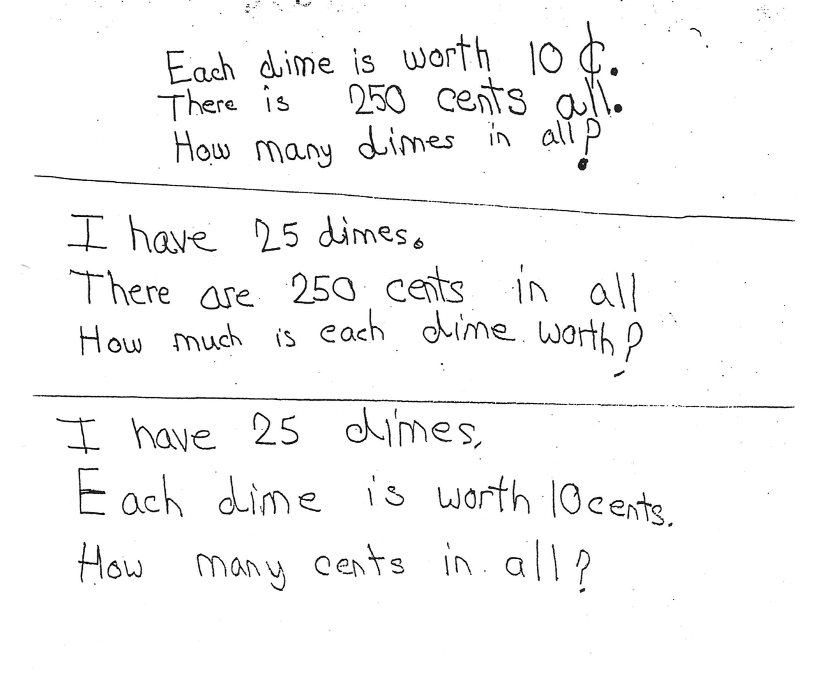
This student (see below) expanded their story about dimes. Can you tell which problem is a multiplication situation and which are division situations?
 Here, a student used geometry as a context for their problems. Integrating topics in math is not only creative but also provides an opportunity to revisit content.
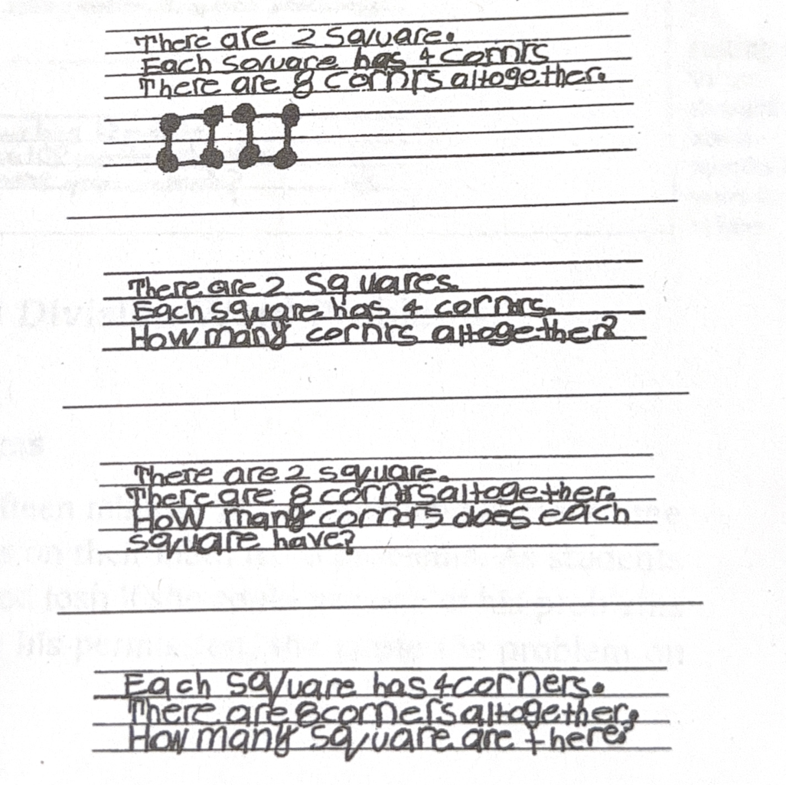
Here’s another example of using geometry as a context for creating word problems:
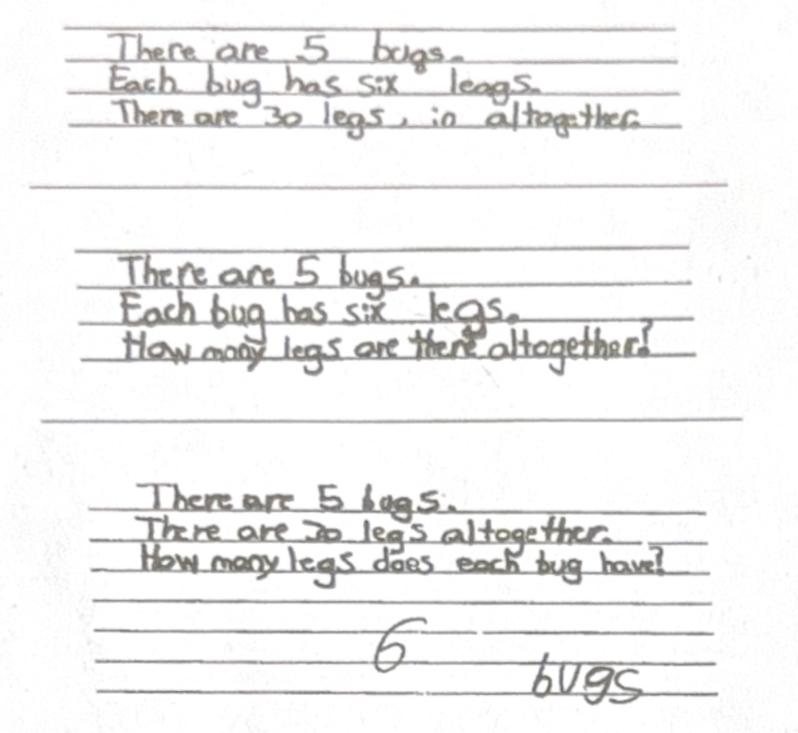
Here are some problems about bugs!
Two Types of Division
To further the cognitive demand in this lesson sequence, teachers can leverage the lessons to point out and explore the different types of division created in the problems.
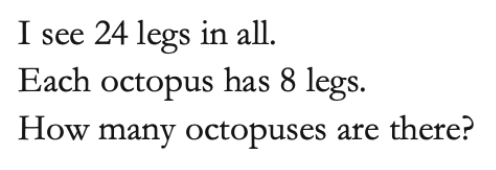
For example, quotative or measurement division can be viewed as the action of separating items into groups of equal size to determine how many groups when the item in each group is known as in the following word problem (the octopuses are the groups, the legs are the items in each group).
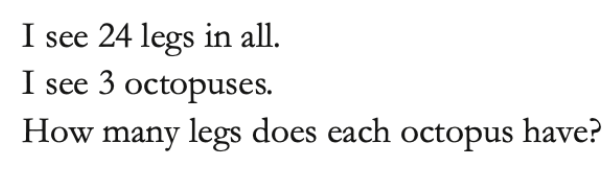
Partitive, or equal sharing division, can be viewed as the action of separating items into groups of equal size to determine how many in each group when the number of groups is known, as in the following word problem (we know how many groups or octopuses, but we don’t know how many legs in each group).
Students need experience with both types of division, and writing stories and math word problems is the perfect way to provide this experience!
Students as Creators of Mathematical Contexts
One of the ways that teachers can modify math tasks so that they are more cognitively demanding is to position students as creators, rather than just consumers, of mathematics. One of my favorite quotes is by Seymour Papert who notes, “The role of the teacher is to create the conditions for invention rather than provide ready-made knowledge.”
Having students create their own math word problems shifts them from passive calculators to active mathematical thinkers. When they create, students engage in higher order thinking; they put their personal stamp on their creations, and guess what? After writing their word problems, a teacher has an entire bank of multiplication and division problems for students to solve. Who needs a math textbook when you have a classroom of authors right in front of you!