The Power of Productive Struggle

Rusty Bresser
On a recent weekend, I was working on a math problem with a friend of mine. The problem included several different questions, beginning with asking us what we noticed and wondered about the following arch pattern. Before reading on, what do you notice and wonder, assuming the pattern continues?
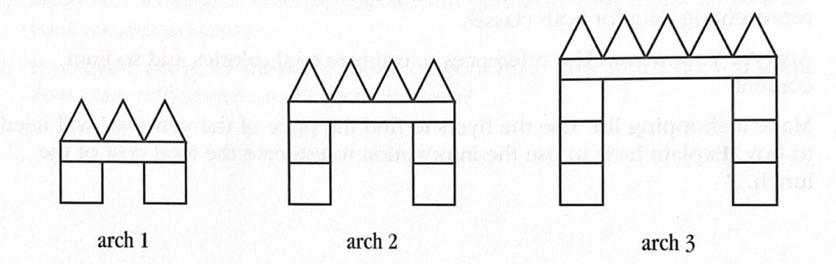
As I scanned the pattern, I noticed that in each arch, the number of squares is twice the number of the arch number. I also noticed that there’s one long skinny rectangle in each arch and that the number of triangles is two more than the arch number. I wondered how many pieces it would take to build arch 4. I was feeling pretty good! This noticing and wondering really helped us get a feel for how the pattern was growing—how it was changing and how it was staying the same.
As we continued to respond to the problem’s questions, I figured out how many pieces I’d need to build arch 4, arch 10, and arch 40 (try it out and see how you do).
The Question that Produced the Struggle
One of the questions in the problem threw me for a loop. Here’s the scenario:
Rose Marie used 48 pieces to make an arch. Which arch number did she make?
At first, I was stuck and almost gave up until my friend gave me a hand by asking some questions, the first one being:
“What do you notice about the number of pieces it takes to build each arch number?”
I thought about this for a minute, and realized that for the even numbered arches, it takes an odd number of pieces, and for the odd numbered arches, it takes an even number of pieces. So, I reasoned that the answer had to be an odd numbered arch since 48 is an even number!
Another question my friend asked was, “What arch numbers do you think the answer might be?” This question served to pique my interest and helped me think about what a reasonable answer might be. Because of my friend’s gentle guidance, I had a way into the problem and continued to persevere. As I thought about the problem, she gently asked a few more guiding questions along the way, giving me space to puzzle through, not stealing the struggle, until I finally figured it out.
What is Productive Struggle?
Productive struggle is often referred to as the sweet spot in the learning process. It happens when a learner is challenged just enough to have to puzzle through a problem, try different pathways, look for patterns, make mistakes, and start again as they try to make sense of whatever they are trying to figure out.
When a problem is too easy, it’s just practice. That’s not to say that we shouldn’t pose problems that are easy for students. When math problems come easy, it can build a student’s self-confidence. But when problems are too easy, they can also inhibit engagement. When a problem is appropriately challenging (and we know that’s different for every student), then the effect can be powerful. Given the right amount of challenge can help students think outside the box, affect their ability to persevere, deepen engagement, and bring joy to doing mathematics. Think of the feeling you get when you’ve solved a tough math problem and didn’t give up. Feels good, right?
What It’s Not
Allowing students to struggle can be a good thing, but leaving students to flounder or experience anxiety to the point of shutting down—this is unproductive struggle. The problem is, we often don’t want to see students experience any anxiety when doing math, so we tend to want to ‘fix’ it and help too much.
Over scaffolding can come in many forms. Modeling too much before students start solving can be counterproductive. Asking leading questions, giving hints, and providing explanations all have the tendency to ‘steal the struggle’ from the learner. The challenge for teachers is figuring out when and how to help.
Providing Support in the Sweet Spot of Learning
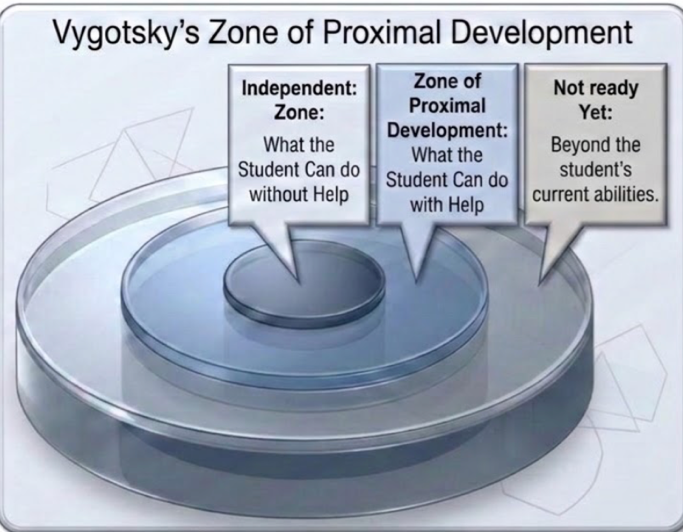 Researcher Lev Vygotsky’s ideas about learners’ Zone of Proximal Development, or ZPD, helps us think about when to provide support. This is a diagram that illustrates the learning process, and in the Zone of Proximal Development is where students, with appropriate assistance, are most likely to stretch their knowledge and understanding of a math concept.
The ZPD is the place where a learner is beyond what they can do by themselves, like when I needed help figuring out what arch number was made from 48 pieces. The ZPD has been called the ‘sweet spot’ of learning, because it’s the time when the most learning can occur and where the cognitive challenges take place. It’s a time when a learner experiences disequilibrium or confusion and a time when the learner can resolve this confusion and come to a place of equilibration through social interaction and other forms of support.
Why Provide Opportunities for Productive Struggle?
Why would you want students to struggle? Easy answer—because it’s good for them! There are many benefits to productive struggle for both students and teachers; here are just a few.
- The process requires students to use their own reasoning and background knowledge when solving problems, and it helps them develop conceptual understanding.
- When students are given more control over their own learning, even when it’s hard (but not too hard), they build confidence and become less dependent on the teacher.
- When given the chance to struggle, students start asking themselves questions, engaging in metacognition: What am I trying to figure out? What do I know already? What part might give me trouble?
- Struggle provides a window into students’ thinking and can increase a teacher’s awareness of the misconceptions a student may have, paving the way for future support.
Creating Opportunities and Supporting Productive Struggle
The best way to provide students with opportunities to struggle productively is to offer cognitively complex and demanding tasks or questions. Cognitive complexity is the amount and type of thinking a math task asks students to do. It’s not just about whether numbers are big or small. Cognitively demanding tasks require students to reason, think critically, make decisions, and explain and justify their math thinking. These tasks engage students in analysis, flexible thinking, exploring concepts and relationships, visualizing, and generating and defending claims.
Tasks that are open-ended or ones that have a low-floor and high ceiling often pose cognitive demands and engage students in productive struggle. The Arch Problem (adapted from Dacey & Lynch, Math for All: Differentiating Instruction, 2009) is a perfect example of a task that poses cognitive challenges but that is also differentiated or tiered so that a range of learners can engage and be challenged in different ways. Notice how the questions gradually become more challenging.
- How many pieces does it take to build arch 5? Explain.
- Build arch 5.
- How many squares does it take to build arch 6? Explain.
- How many pieces does it take to build arch 10? Explain.
- In general, how can you use the arch number to find the number of triangles?
- How many pieces does it take to build arch 40? Explain.
- In general, how can you use the arch number to find the number of squares?
- Rose Marie used 48 pieces to make an arch. Which arch number did she make? Explain.
- Explain how you can figure out the number of pieces it would take to make any arch number.
Another example of a task that provides opportunities for productive struggle is the garden problem for primary students.
“Sam picked 8 flowers from his garden. He picked some red flowers and some yellow flowers. How many are red? How many are yellow? Show all the different possible combinations.”
This task is accessible to a range of learners; some will find all the combinations, while others, like the student below, will find four different combinations and struggle to find more.
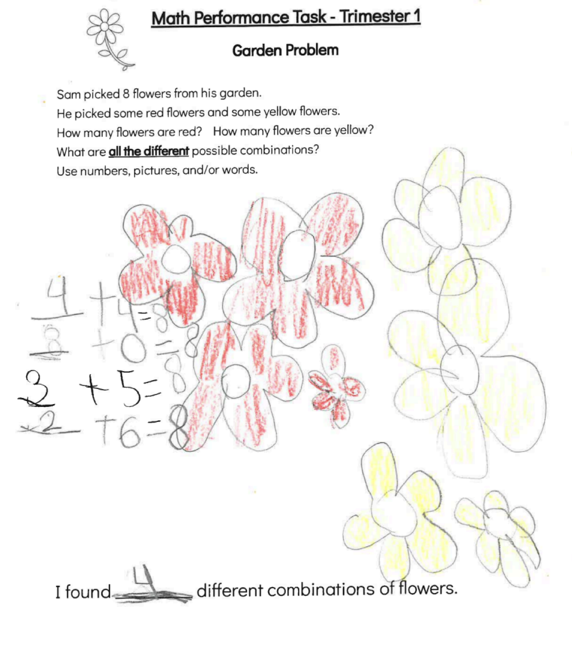
When a student hits a wall but has already found a few solutions, it’s the perfect moment for productive struggle. The goal isn’t to give them the answers but to help them build a systematic way of thinking. The following questions can gently nudge students to expand their thinking and move forward.
- Validating and Activating What They Know
-
-
- Before moving forward, validate what they’ve already done to build up their confidence by asking, “You’ve already found four combinations! How do you know for sure that these four are correct?”
- Or, you might say, “Can you read the combinations you have so far? Let’s look at what they have in common.”
-
- Shifting from Random to Systematic Thinking
-
-
- “I see you have 3 red and 5 yellow flowers. What would happen to the number of yellow flowers if we added just one more red flower?”
- “Is there a way we could organize the combinations you’ve already found so they go in order?”
-
- Using Visual or Concrete Tools
-
-
- “Would it help to use these red and yellow counters to act out the combinations you already have?”
- “Can you draw 8 circles on your paper and color some red and some yellow to see if a new pattern pops out?”
-
- Encouraging Perseverance (the Notice and Wonder Mindset)
-
- “How many total combinations do you think there will be?”
- “If a friend came over and was stuck on this exact spot, what advice would you give them to find just one more combination?”
Keeping the Cognitive Lift on the Student
Supporting struggle is one of NCTMs eight effective teaching strategies. “Supporting productive struggle helps students transition from seeing math as a race for quick answers to recognizing that problem solving takes time, creativity, and perseverance (NCTM, 2014).”
Providing time to think, asking thoughtful questions that don’t steal the struggle, and offering manipulatives or visuals like the one in the Arch Problem, are all supports that can go a long way in helping learners stay in the game, keep interested and engaged, and solve just-out-of-reach problems. So, the next time you notice a student stuck on a math problem and you feel the impulse to rescue, consider strategies that further their thinking, keeping the cognitive lift on the student. The effect can be powerful.