Centipede’s 100 Shoes Viewing Student Work through a Strength-Based Lens

Rusty Bresser

Centipede’s 100 Shoes
In a recent post (access it here), we talked about how children’s literature can be an effective way to provide interesting contexts for math problems. In Tony Ross’ Centipede’s 100 Shoes (2002), there are at least two different opportunities in the story that can lead to terrific math problems for second, third, and fourth grade students to solve. It’s a fun, silly story about a creature many of us know little about. Did you know that these animals have been around for over 400 million years? There are more than 3,000 centipede species, and they don’t have 100 feet, which their name implies.
The story begins with a little centipede who, while walking along, hurts his toe. “Ow!” he yells. When the centipede’s mom finds out he hurt his toe, she takes him to the shoe store, where he buys 100 shoes, “because centipede means a hundred feet,” he explains to the shoe seller (he ends up realizing he only has forty-two). As the story progresses, the little centipede soon finds out that putting on and taking off so many shoes (not to mention the socks) is annoying. So, he decides to return to his shoe-less life and give all 100 shoes to his animal friends. He gives them to five spiders, four beetles, two woodlice, a grasshopper, and two worms. Which begs the question, “How many shoes did each animal group get?”
Using the Book in Math Class
When I use Centipede’s 100 Shoes in classrooms, I begin by asking students if they’ve ever heard about centipedes; this question usually piques their interest. Then I show them the cover of the book and ask them what they notice and whether they have ideas about what the story will be about. Next, I read the book all the way through to the end. After finishing, I elicit from the class the names of the animals the centipede gave his 100 shoes to and how many in each animal group and record on the board or chart paper: 5 spiders, 4 beetles, 2 woodlice (woodlice have 14 feet!) 1 grasshopper, and 2 worms (one foot each). Students really get a kick out of brainstorming and discovering how many feet each animal has. Finally, I pose the math question: “How many shoes did each animal group get?” I love this question because it requires students to engage in problem solving. They must figure out what information they need (e.g. numbers), what operation or operations to use, how they are going to represent their thinking, and when they get a result, they must determine if it makes sense or not.
Viewing Student Work Through a Strength Based Lens
When I used to pour over student work samples, I focused on the mistakes and how to help fix them. Now, I start by looking for what students CAN do, letting them know what I notice about their strengths. Strengths sometimes come as surprises to students, especially those that struggle with math. Highlighting a student’s strengths bolsters their self-image as a mathematician. The message is: You’re smart; look what you can do!
I also want to give students specific feedback to let them know what their areas for growth are. This feedback often comes in the form of questions that prompt a student to use my feedback to further their learning. Providing just-in-time, specific feedback to our students has been shown to be one of the most significant activities a teacher can engage in to improve student achievement (Hattie, 1992).
Let’s look at some student work samples and analyze how a group of third graders responded to the question, “How many shoes did each animal group get?”
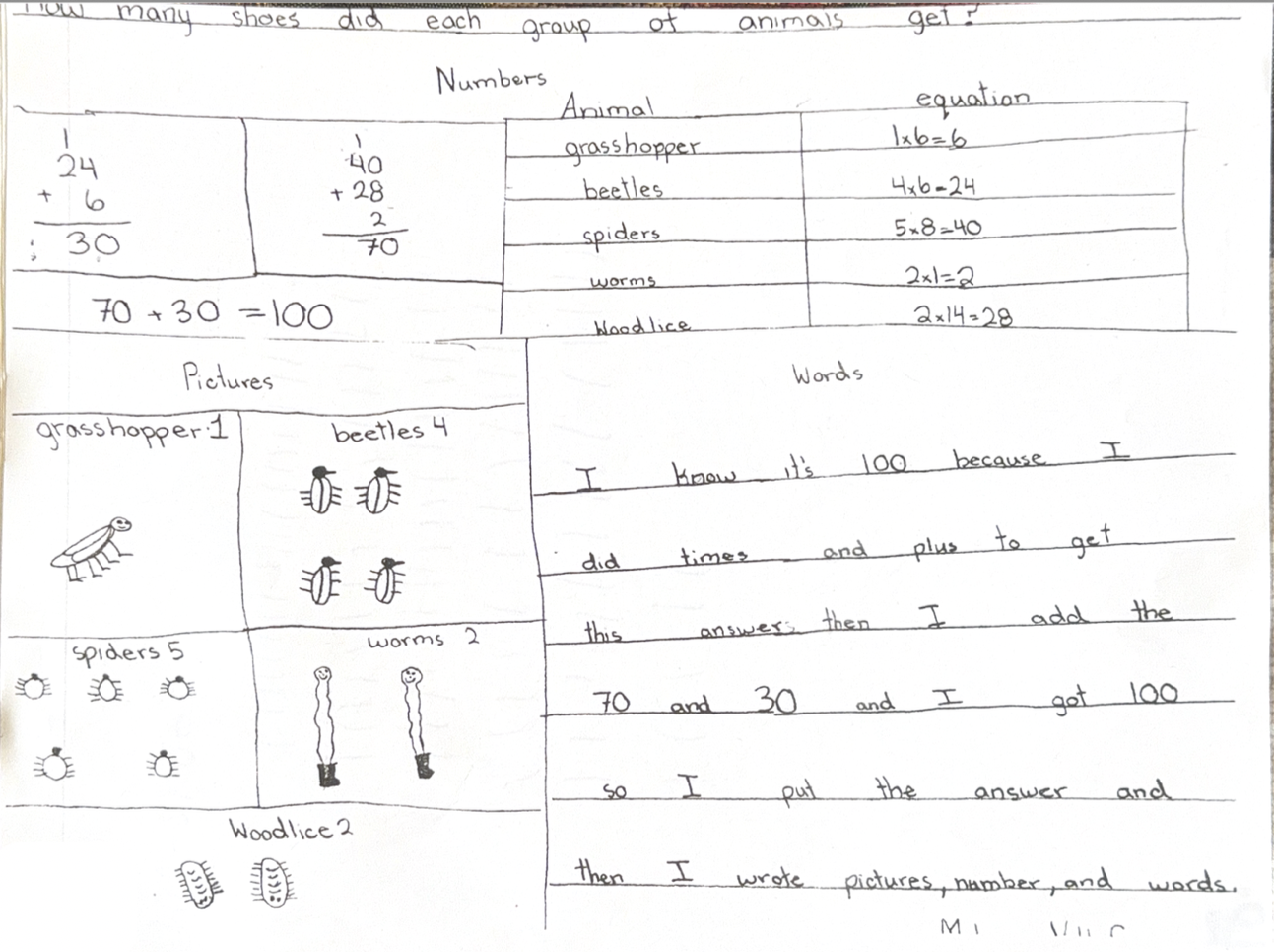
Below is an example of a high-performing student. Math seems to come easy to her, and it’s often difficult to know what feedback to give that would help her grow and expand her horizons. There are so many strengths here! I usually start with, “I notice….” For example, I might say “I notice how organized your work is! I notice that you use multiplication to show how many shoes each animal group got from the centipede. You use addition efficiently and accurately, and you use pictures and equations as models. Your labels show me that you are using the information in the problem/story in your work. And your words report what you did to answer the question.”
My constructive feedback is usually short, maybe one or two things to work on. In this case, I might start with a question: “Why did you use multiplication?” Then I’d ask her to explain what the numbers mean in her multiplication equations.
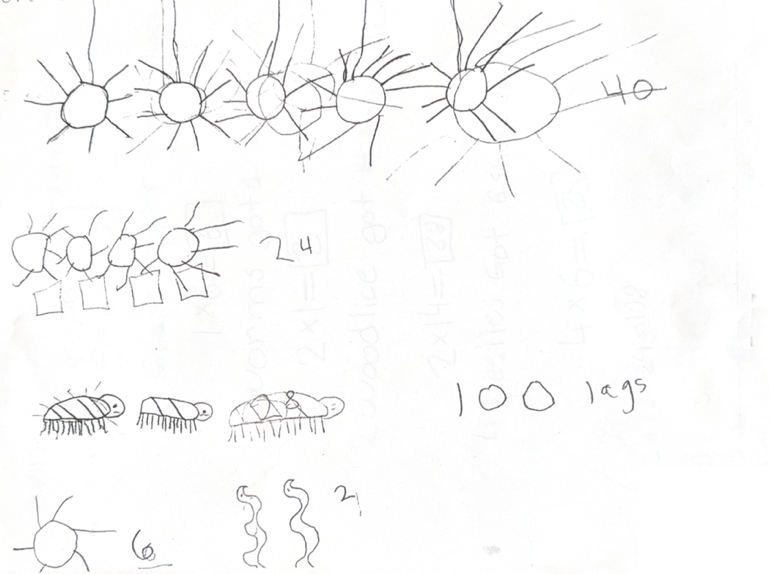
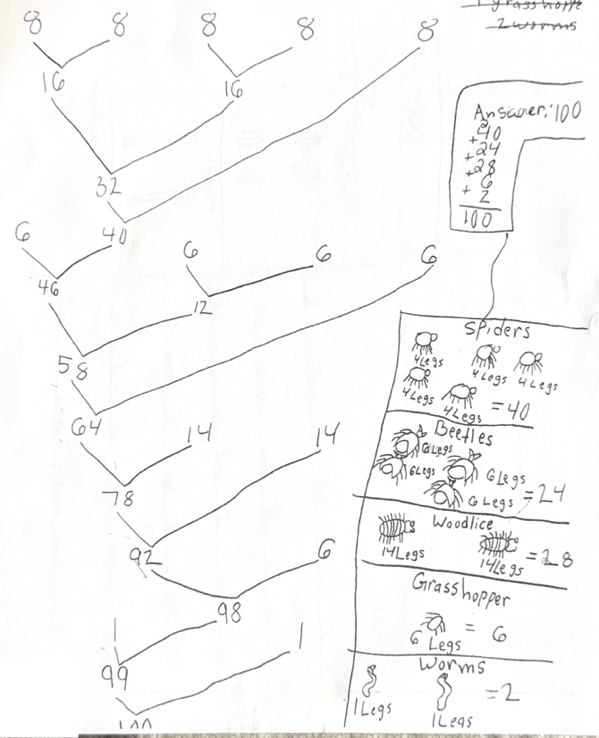
Just as we have students in our class who seldom struggle with math, we also have those who need more support. For example, this student (see below) uses effective picture models to represent the problem. He correctly shows how many shoes each animal group gets, answering the math question that was asked. I might ask him how he figured the total for each group; did he apply multiplication? Addition? Or did he count, and if so, how?
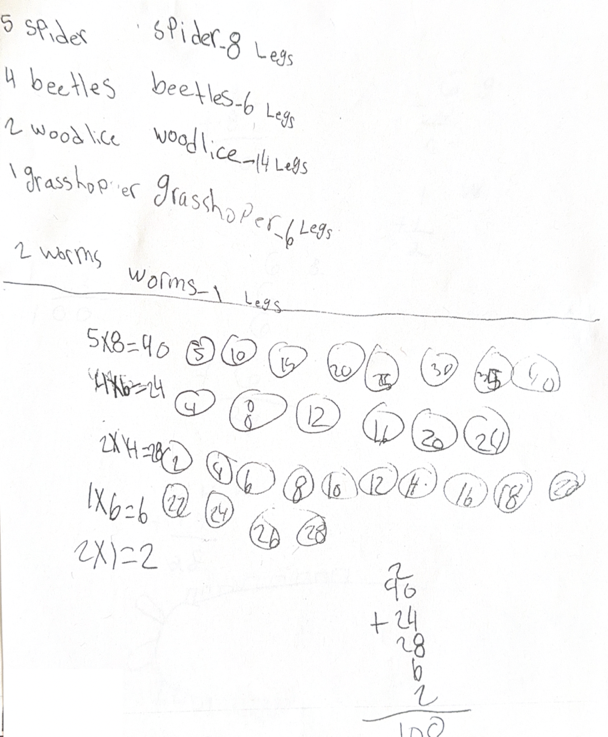
This next student uses labels to note how many legs or feet each animal has. She uses multiplication to find the total number of shoes for each animal group and shows how she figured the multiplication through skip counting. I’d be curious whether she could explain her problem-solving process using words.
Here, the student uses two different models, pictures and addition equations. Their method of finding the total number of shoes is clever and interesting, something the rest of the class might benefit from seeing. I’d be interested in asking the student if they could use multiplication to figure the total number of shoes for each group.
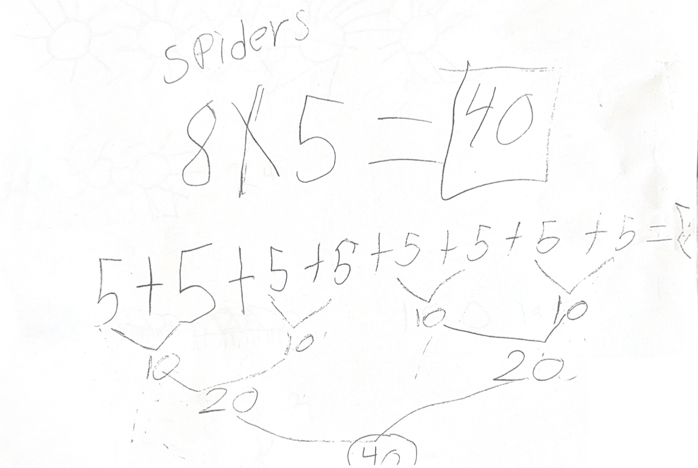
And finally, this student correctly arrives at the number of shoes a group of five spiders would get and uses addition to show what their multiplication equation stands for. I might ask the student about the factors and product in their multiplication equation. What does the 8 represent? How about the 5 and the 40? Is it 8 groups of 5 or 5 groups of 8?
A Problem for Second and Third Graders
There’s another math problem waiting to be solved in Centipedes 100 Shoes, appropriate for second and third graders. In the story, the little centipede goes shopping with his mom, and he buys 100 shoes. When the shoe seller asks, “Why 100 shoes?” the little centipede replies, “Because I’m a centipede, which means a hundred feet.”
When the little centipede gets home, he tries on his shoes, and when he’s finished, he has fifty-eight shoes left over. That’s where I stop reading and pose this question: “The little centipede bought 100 shoes. When he was finished putting the shoes on all his feet, he had 58 left over. How many feet did the centipede have?”
In this problem, the number of feet the centipede has is unknown. What’s known is how many shoes he has in all and how many he has left over. Will students see it as a change unknown subtraction problem or a missing addend problem (100 – ___ = 58. Or, 58 + ___= 100)? Will they use an open number line? Will they round to a friendly number? Will they make use of tens or multiples of ten? It’s a terrific math question that engages students in decomposing 100. And, it also begs the question, how many feet do centipedes really have? In the story, the little centipede’s grandad tells him that most centipedes have 42 feet. But in the world, centipedes have anywhere from 30 to over 350 feet, and they always have an odd number of foot pairs!
Changing How We Perceive Our Students
In a recent blog post, we discussed ways to change how we perceive our students (access the post here). Rather than seeing them as “high” or “low,” we can first look for their strengths and share with them what we notice, helping our students build strong math identities and reshaping how we see them.
Whether or not students are solving math problems that spring from children’s literature, like Centipede’s 100 Shoes, viewing their work through a strength-based lens shifts the focus from what students cannot do to what they can do, fostering deeper engagement, higher achievement, and increased confidence. Focusing on what students understand and can do provides us with a positive starting point for targeted interventions and differentiated instruction. Let’s make that shift!