Hit the Target Range: Estimation Activities for Grades 3-5

Rusty Bresser
Have you ever wondered how many dimples a golf ball has (a golf ball’s dimples are the little indentions you see all around the ball’s surface area)? Probably not, and neither had I until my colleague Karyn Conner posed the question during an estimation game recently. She asked us to give her a range estimate (like 30 to 40 dimples, for example).
The problem is, unless you are a golfer, giving a range estimate about golf ball dimples is hard without a visual of the ball. I really had no idea, no reference, no benchmark (like, what does 10 dimples look like?) to guide my estimating. For those of you who are interested, actual golf balls have anywhere between 300 and 500 dimples.
Benchmarks are Key to Guiding Our Estimates
Karyn’s question about dimples got me thinking about range estimates. And when a friend of mine was making pancakes recently (yes, the same friend whose pancake making inspired our blog post about fractions – access here), he showed me a 6 oz. container with Red Currants that he planned to use in the recipe. All I could think of was range estimation.
So, how many Red Currants do you think there are in the visual below? With kids, I might offer the following frame to help them explain:
I estimate that there are between ____ and ____ because _________________.

Having a visual image (or, the real thing) really helps. When I asked a few friends for a range estimate, every one of them used a benchmark. For example, when explaining their range estimate, they said things like, “I counted 10 currants and imagined how many groups of 10 there might be and then multiplied to get a range estimate.” And when I showed them the following images, their estimates improved.
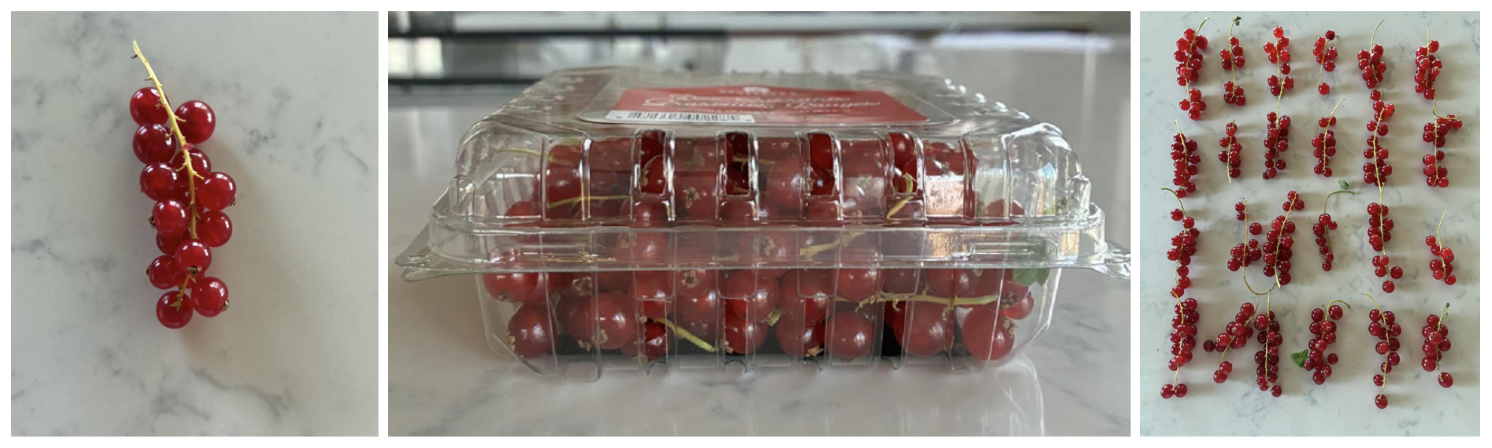
The visuals I provided gave my friends benchmarks or references that helped them narrow their range estimates and come close to the actual range: 250 to 300 Red Currants per 6 oz. container. Benchmarks are helpful because they act as mental handholds, allowing the estimator to replace complex numbers with easy-to-manipulate “friendly numbers” (like 10 and multiples of 10).
Benchmarks also give us an immediate “reasonableness” gauge, helping the estimator get ‘in the ballpark’. Benchmarks also can establish a relative scale. For example, if the estimator reasons that there are about 10 currants in a bunch, they can use the information to better imagine the scale of their final estimate. Benchmarks help us move from random guesses to a guess that’s based on mathematical reasoning.
Estimating in the Real World
When we use arithmetic in the real world, we estimate about half the time and find accurate answers about half the time. We estimate when figuring a tip, measuring ingredients, determining how much we’ll save on sale items, and contemplating how much time it will take to go from here to there. We also use range estimation; estimating a drive will take a range of 20 to 30 minutes depending on traffic lights or guessing you’ll need between 4 and 6 potatoes to feed a group of guests. Estimation is everywhere!
But what happens in the classroom? In elementary curricula, about 90 to 95% of practice problems ask students to generate exact, accurate answers (Inquiry in Education, 2022). No wonder students’ number sense is lacking!
Why is Estimation Important?
Estimation is the foundational building block of number sense. Rather than just guessing, estimation requires students to understand numerical relationships, scale, and place value. It’s vital in elementary math because it serves as an “internal check” helping students instantly spot if an exact calculation or calculator error is drastically unreasonable. Estimation forces the user to think flexibly and helps accelerate learning by moving away from rote memorization.
When estimating how many red currants are in a 6 oz pack, my friends didn’t need an accurate answer. But they did need an answer that was reasonable and ‘in the ballpark’ so that it made sense. And in doing so, they used computational estimation, an important skill that students can develop while playing games like Hit the Target Range (Math Workshop Essentials, Bresser & Holtzman, 2018).
Hit the Target Range: Grades 4 & 5
In this estimation game, students work in pairs, multiplying numbers together to produce a product that falls within a predetermined range. The goal is to hit the target in as few steps as possible.
Teaching Directions
- Players choose or are given a target range (800-850 for example), in keeping with the kinds of numbers they are comfortable with.
- Player 1 chooses a number between 1 and 100 (50, for example).
- Player 2 chooses another number to multiply the first number by, either mentally or with a calculator (50 x 10, for example), and Player 1 verifies and records the result.
- If the product doesn’t hit the target range, Player 2 goes back to the original number and multiplies it by another number (again, either mentally or with a calculator), and Player 1 verifies and records the result.
- Players repeat Step 4 until the product falls within the target range.
- Players repeat the game, this time alternating roles.
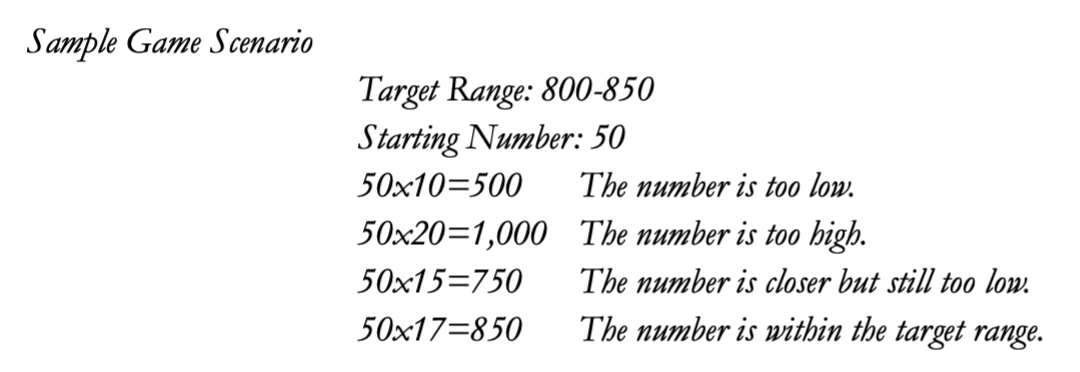
Knowing that they can use a calculator to eventually figure out accurate results, students are free to make estimates until their answer falls within a range. I love this game because it allows students the freedom to explore what happens when we operate on numbers. Estimating in this game forces the user to think flexibly, apply conceptual knowledge (for example, multiplying by 10 and multiples of 10), and spot when the result of their multiplication is too high or too low.
The following questions, which can be asked while students are playing the game, during a class discussion afterward, or as prompts for a reflective writing assignment will help stimulate students’ thinking and generate important discussions:
- What numbers were difficult to start with, and which were easy? Why?
- What strategies did you use when calculating mentally? Explain.
- Did you change the target range? If so, what new target range did you use? How did the target ranges compare?
- Did you ever start with a number that was greater than the target range? If you did, explain what happened.
- How did the calculator help you in playing this game?
- Did you have to use decimal numbers in the game? If you did, explain what happened.
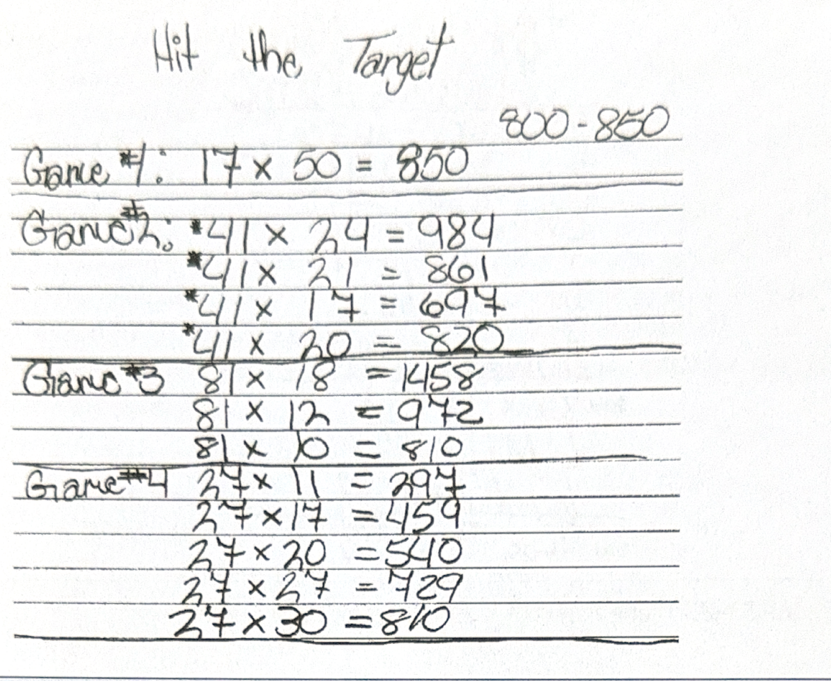
Here’s an example of a recording sheet that two students used to document their games. They experimented with several starting numbers, at times using decimal numbers to get into the target range of 800-850.
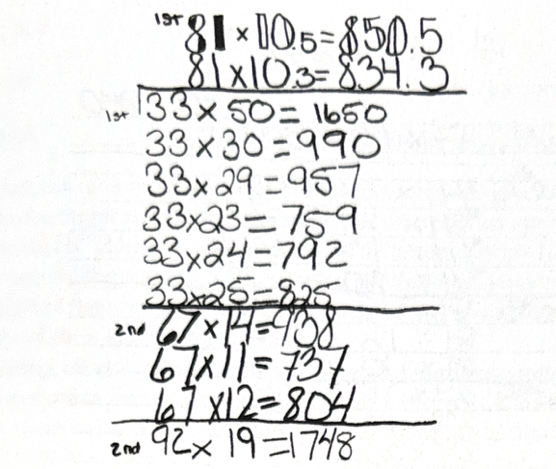
Here’s another example. These students hit the target on their first move in game #1. Using a calculator freed them to experiment with multiplication, raising awareness of what happens when numbers are operated on. The game also gave them practice with mental computation, especially multiplying by 10 and multiples of 10 and other benchmark or friendly numbers.
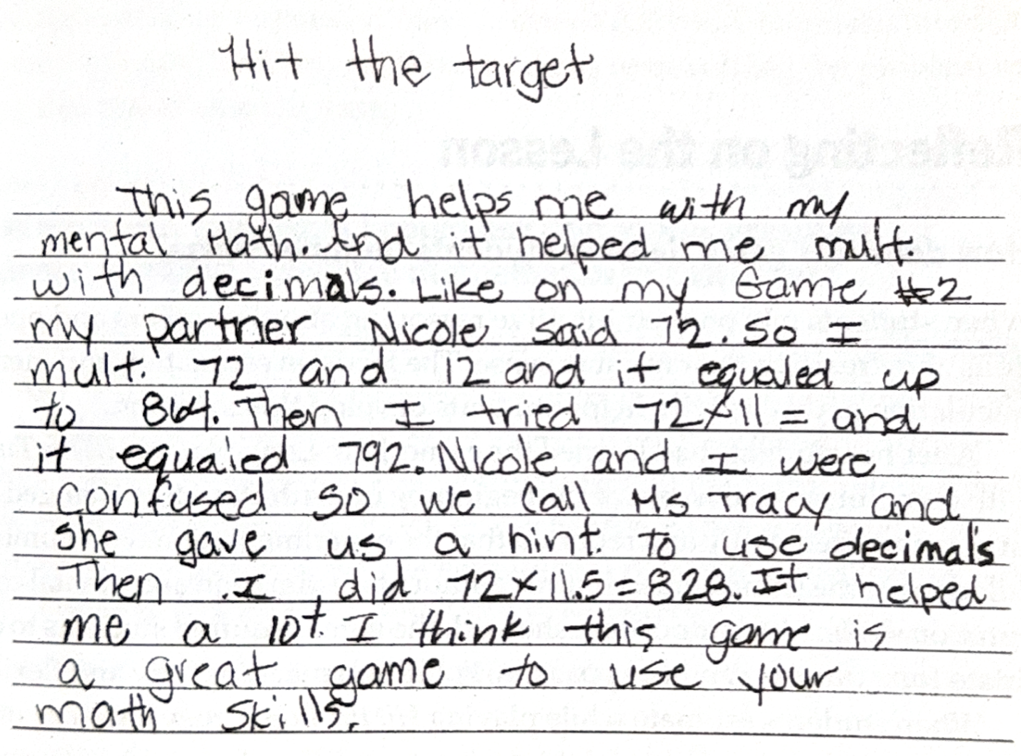
Having students write about the game gives them a chance to reflect on what they learned (see below).
Range Estimation Jar: Grades 3-5
Using an estimation jar is another range estimation task that requires students to reason about number magnitude and use benchmarks. Here’s how it works.
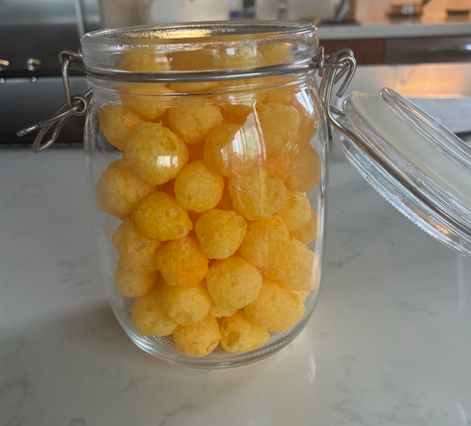 Show the class a jar filled with items – cheese puffs, jelly bellies, cubes, beans, pasta, anything so long as the items
are about the same size.- Ask students to estimate how many are in the jar using a range. For example, you can provide them with one of the following sentence frames:I estimate there are between ____ and _____ cheese puffs because________.I estimate there are at least ____ and no more than ____ because________.
- Have students share their range estimates and their reasoning.
- Take out 10 items from the jar, and see if students want to change their range estimate.
- Elicit students new range estimates.
- Continue taking 10 items out of the jar until all items are counted, and see how students’ range estimates change along the way.
In the Range Estimation Jar activity, students often use benchmarks or samples to guide their estimation. For example, look for students to say things like, “I counted a group of ten cheese puffs and then visualized how many groups of ten there would be in the jar.” This reasoning is like what my friends used when estimating Red Currants and signals good number sense.
The Power of Estimation
Providing opportunities for your students to estimate helps them develop their number sense by requiring them to think flexibly about quantities, magnitudes, and number relationships. And it’s easy to integrate estimation into your math teaching! For example, rather than asking, “What’s the answer to 1/2 + 1/3, ask “Is 1/2 + 1/3 less than or greater than 1?” Before a student solves a problem, ask them to estimate the answer, or ask them to make a range estimate. These questions will help them shift from procedural thinking to using their number sense.
Estimation questions require students to access conceptual knowledge, reason flexibly, and think outside the box. Requiring students to give a range estimate not only opens possibilities but also eases the pressure to produce one correct answer. And, providing benchmarks helps guide their thinking and get ‘in the ballpark’. Since we use estimation so much in our daily lives, doesn’t it make sense to help students become good estimators?