The Visual Image Math Routine: Stories from Three Transitional Kindergarten Classes

Rusty Bresser
Transitional Kindergarten: A Place Where Math Happens
Transitional kindergarten provides young children, typically four-year-olds, with an extra year of age-appropriate learning to develop essential academic and social-emotional skills so that they’re well-prepared for kindergarten. It can also be an exciting place to watch children engage in mathematics, honing their counting skills in interesting ways. It’s a place where math happens!
Math Transformations CEO Andrea Barraugh and I spent some time recently visiting different TK classrooms, observing young children and their teachers at work. In this post, we’ll relate our experiences and share how the Math Transformations Visual Image Slide Deck can be used. You can access the slide deck here.
Three Schools, All Different
The schools we visited were all very different. We observed at a charter school on the Barona Indian Reservation, an elementary school in southeast San Diego with a large Latino student body that has approximately 45% designated as multi-language learners, and an urban public magnet school set in a middle-class neighborhood in San Diego. While these school’s student populations are very different, the common threads that connect them are their enthusiastic young learners and their wonderful teachers.
What’s a Visual Image Math Routine?
Visual images can prompt students to look at the world through a mathematical lens. Depending on the questions we ask, students can quantify, describe, compare, measure, and wonder when shown an image. The routine naturally differentiates because students can make observations about things in the image that they notice and engage in mathematics in ways that make sense to them. The routine is a way to motivate students because it involves images from the world that they may connect with. And it also offers opportunities for young children to develop their oral language skills as they describe the things they see.
The Math Visual Image Routine is simple: Show the class a visual image, then ask them questions such as…
- What do you notice?
- Where do you see…?
- How did you count?
- Did anyone see something different?
Following are snapshots from three different classrooms.
Morgan’s Class
Walking into Morgan’s transitional kindergarten classroom, I’m struck by the buzz of children’s voices as they work at different tables on shape and letter puzzles. Some are huddled around a teacher assistant’s desk, stacking and counting plastic cups. Others are sitting on the front rug with Morgan, listening attentively as she reads them a story. School had started that day only a few minutes earlier, and already these four-year-olds are immersed in learning and social interaction.
When Morgan assembles the class on the rug for morning meeting, she takes advantage of every opportunity to engage her students in counting. Pointing to the schedule of the day, she asks, “How many things are we going to do today?” prompting the children to count as she models one-to-one correspondence.
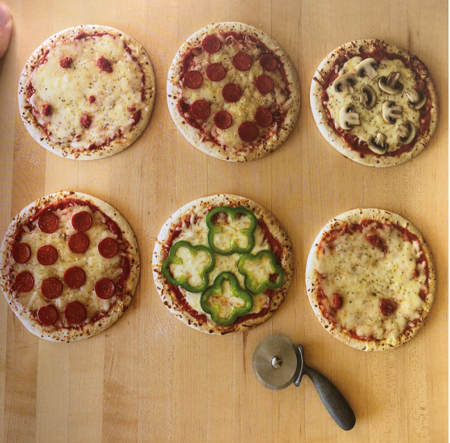 Next, Morgan reveals a slide with a picture of six different pizzas from Math Transformation’s Visual Image Slide Deck. “Pizzas!” the children chorus. “What kind of pizza do you like?” Morgan asked. “Tell your neighbor what you like on your pizza. I like….”
I was impressed that these four-year-olds knew how to engage in a partner talk, assisted by Morgan’s oral sentence starter that she offered. It’s apparent that Morgan has modeled and provided time for students to practice partner talks.
After students share what they like on their pizza, Morgan asks them to count some or all the pizzas on the screen. The room erupts in a buzz of counting. A few students walk up to the screen and count. Others use their fingers and count from where they sit. After several seconds, Morgan asks them to share with a partner how many they had counted. Again, she provides an oral prompt: “I counted ____ pizzas.”
Next, Morgan brings them back together and has students share out. “I counted two pizzas!” a student exclaims. “Come up and show us which ones you counted,” Morgan responds. The student comes up to the screen and counts the two cheese pizzas. “Ah,” Morgan comments. “So, you counted the two cheese pizzas! Class, show me your signal if you also counted the two cheese pizzas.” This ‘me too’ signal helps children connect with others’ ideas and strategies.
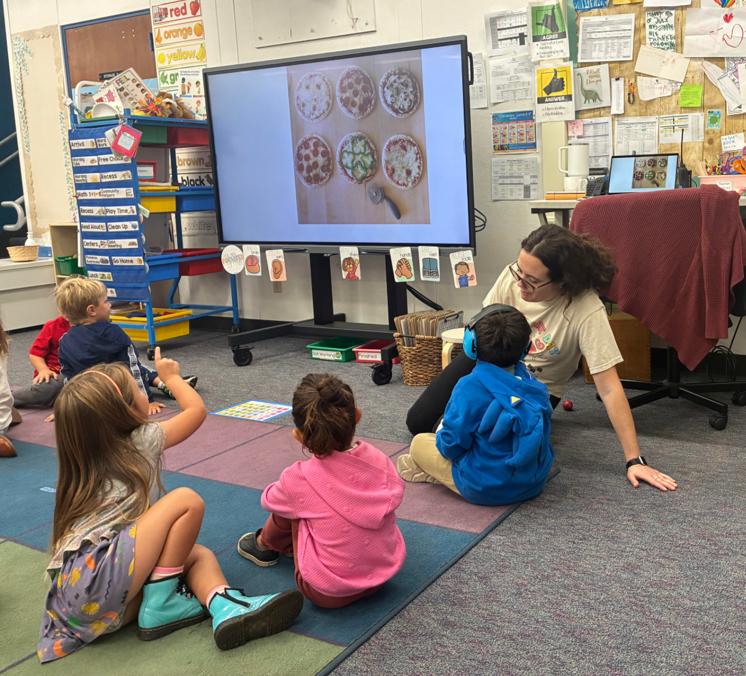 Asking the students to count all or some of the pizzas is a way to differentiate and allow for different ways to interpret the counting question. In fact, Morgan could have asked the students to just count what they saw. For example, some might have counted the pepperonis on one of the pizzas or just the mushrooms or slices of bell pepper. Or, she might have asked the class whether there are more pepperoni or mushroom pizzas. There are so many possibilities in this simple yet rich routine.
Another student counts three pizzas. When Morgan asks her to come up and show, the girl points to and counts the three pizzas in the top row. “So, you counted the three pizzas in the top row,” Morgan observes, modeling math language. “What about the bottom row?” This question pushes the class to begin to think about combining groups (three on the top and three on the bottom makes six).
Morgan wraps up the routine by showing the class a little bag. “I have some stuff inside. Watch!” She spills the contents onto the document camera, creating another visual image for her students to count. The children excitedly begin to choral count the objects from the bag as I make my way out of the room.
Sierra’s Class
It’s the fifth day of school and the fourth consecutive conversation the class has had about visual images. Sierra begins the routine by showing her students the following image and asks them what they notice. The students instantly start to count what they see.
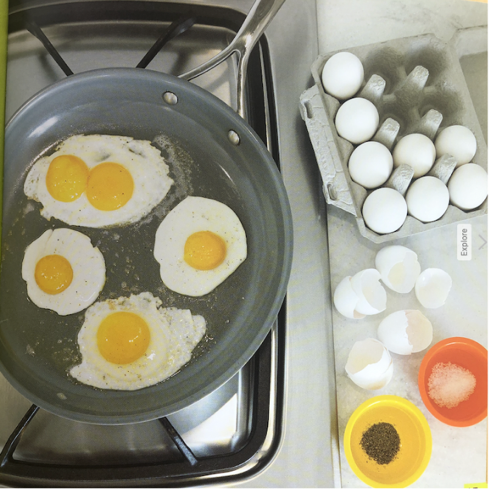
One student says that he sees eight eggs. Sierra asks, “Where do you see eight eggs?” He comes up to the board and points to the eggs he sees while Sierra circles them. Then, he counts them one-by-one (see photo below). Sierra’s expression is priceless as she watches him count. When he’s finished, Sierra leads the class in a choral count.
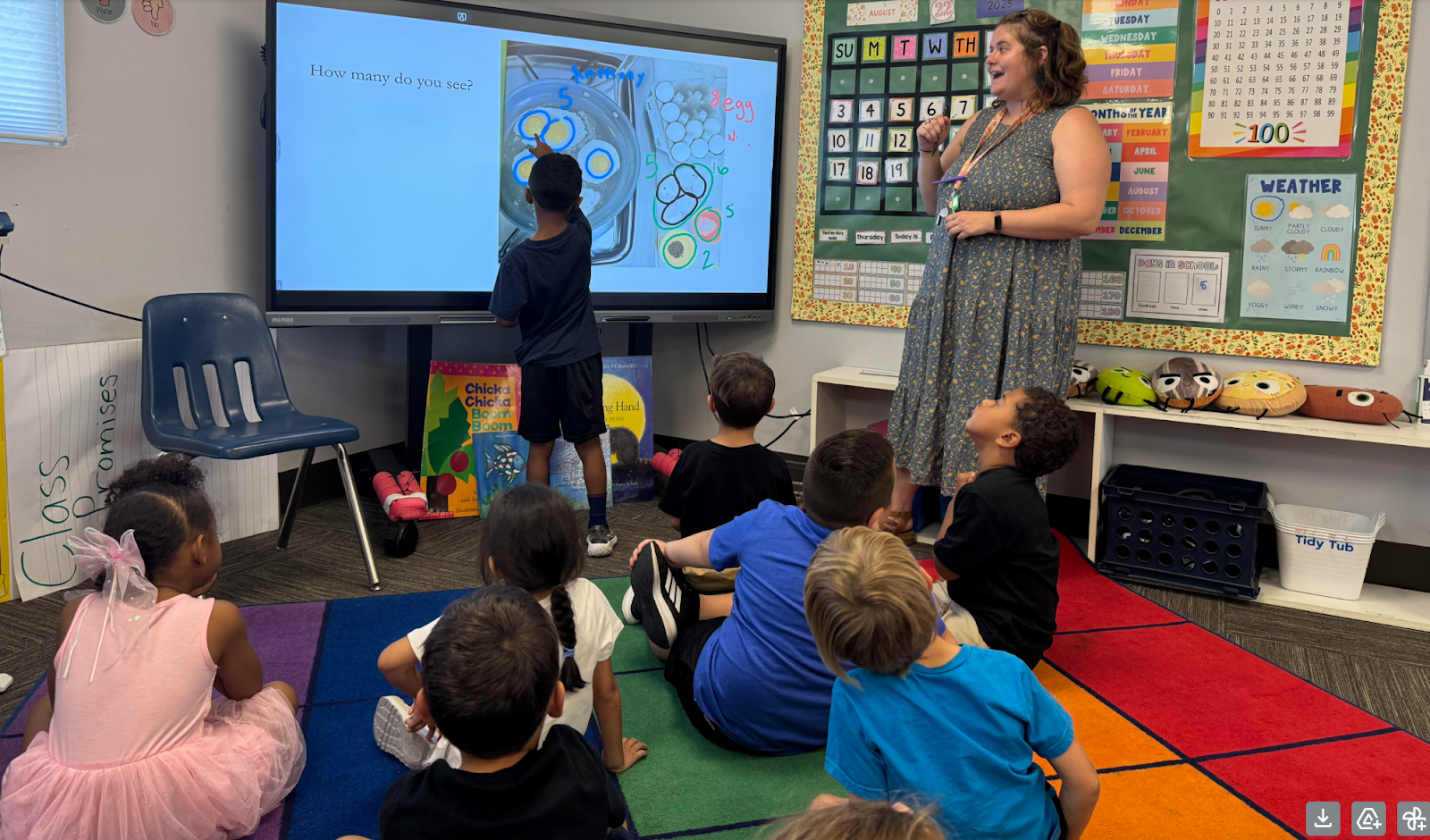
“Did anyone see something different?” One student exclaims, “I see groups of two eggs!” “Where do you see groups of two?” Sierra asks. As the student shows, Sierra circles the groups of two. As Sierra is circling groups of two eggs, one student begins to count them by 2s, “2, 4, 6, 8, 10…” This was a big surprise for Sierra and is evidence that the routine can be used to formatively assess students’ counting skills. How far can her students count? Can they skip-count? Do they know the number names? Do they know the counting sequence? Do they point to each object as they count and say the number? So much to find out!
The idea of grouping spreads across the room, and one student who had originally counted the eggs by ones wants to count them by twos. Someone else shouts, “I can see groups of bubbles!” What was one student’s epiphany results in a new counting strategy for others.
One girl comes forward and points to the yellow bowl of pepper. She doesn’t have a clear claim about what or how many she has counted, so Sierra offers guiding questions so the student can successfully share out.
Sierra -“What did you count?”
Student points to the pepper – “That.”
Sierra – “What is that?”
Student – “Pepper.”
Sierra, pointing to the salt – “And what is that?
Student hesitates, then says – “Salt.”
Sierra – “Oh, so you counted the bowls of salt and pepper. How many bowls of salt and pepper do you see?” Sierra circles the bowls.
Student, pointing – “One … two.”
Sierra writes 2 and an initial for that student’s name.
Sierra – “Who else saw two bowls of salt and pepper?” Many students use a hand gesture to indicate, “me too.”
Sophia’s Class
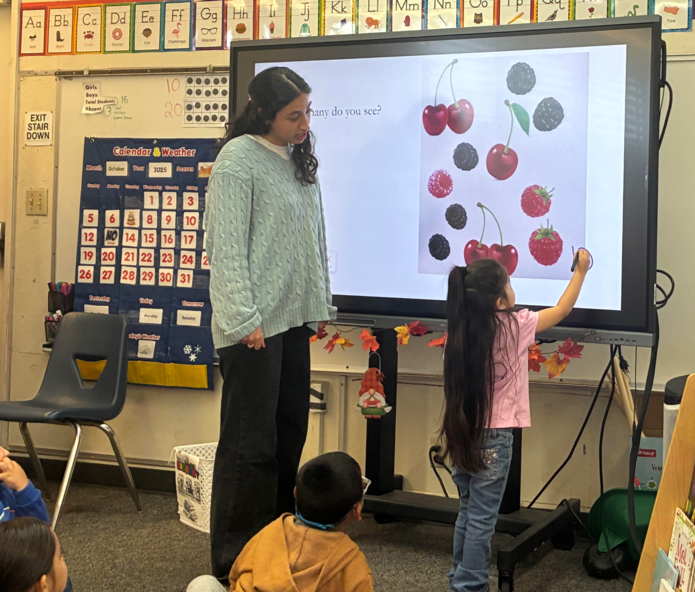 When I visited Sophia’s class, a group of PhD students from the University of California at San Diego came along, all interested in educational research and curious about math in transitional kindergarten. When we arrive, Sophia gathers her students on the front rug, showing them a visual image from Math Transformations Visual Image Slide Deck.
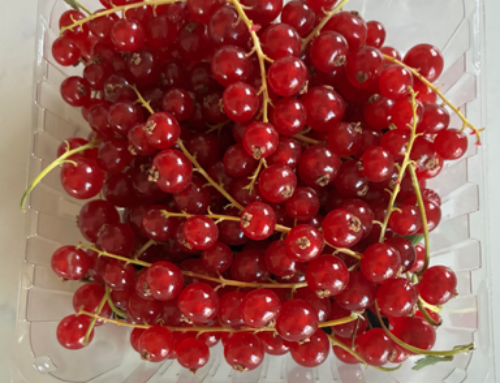
“What do you see?” Sophia asks. Students start calling out names of fruit, “Berries! Cherries!” “How many do you see?” We hear lots of different answers – 5, 6, 10. A girl walks up to the screen, and Sophia hands her the pen. “Go ahead and count them!”
The girl counts 10 berries and cherries, pointing to them as she counts. She misses one and counts each group of cherries as one count. Sophia is fine with this and encourages the student to write the number 10 on the screen. “Let’s count them together,” Sophia says. The class counts 13 pieces of fruit as Sophia points to each piece of fruit, modeling one-to-one correspondence. “So how many are there?” A few students say 13, but most start to count again. While many four-year-olds can understand that the last number spoken when counting represents the total quantity, some are still constructing the cardinality principle.
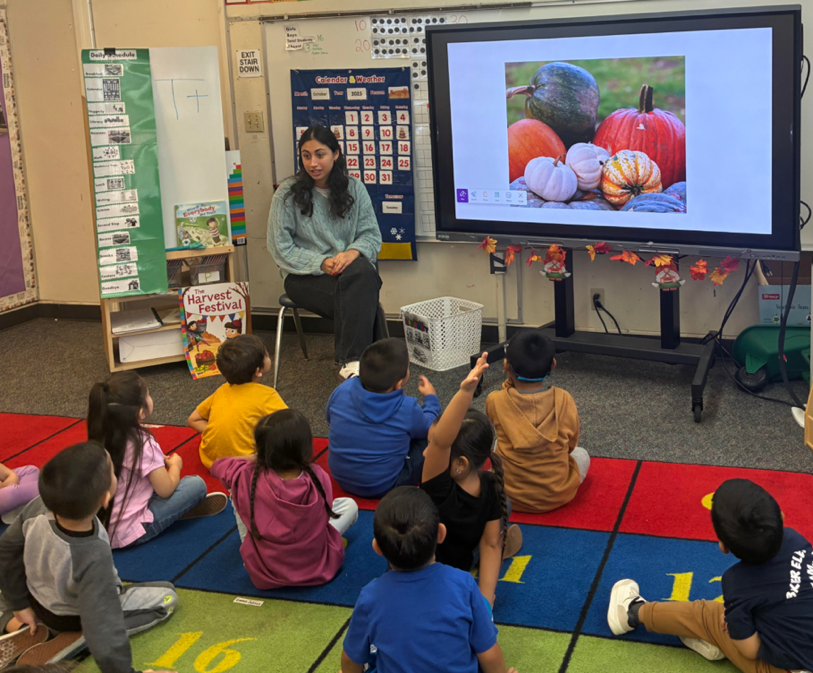 Sophia shows another image.
“Pumpkins!” students chorus.
“How many of you have carved a pumpkin?” Sophia asks, tapping their prior experience. Lots of hands wiggle in the air. “How many pumpkins do you see?”
“I see two orange pumpkins,” someone says. “I see five,” someone else counters.
Sophia asks a few more questions before calling a student up to count the pumpkins.
“How many green pumpkins do you see?”
“How many different colors of pumpkins do you see?”
“How many small pumpkins do you see?”
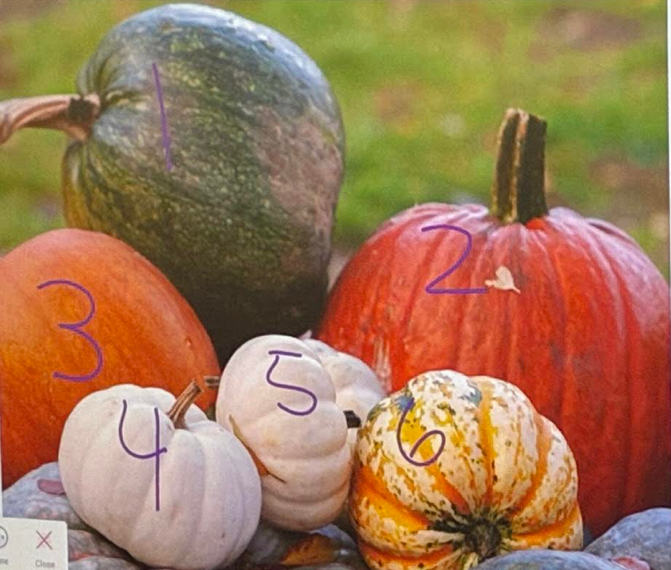
A student comes up to the screen and counts the pumpkins one by one. Sophia writes the numbers on the pumpkins as he points to each one and counts, “1, 3, 4, 6, 5, 2,” jumbling the numbers but including them all. He hasn’t yet understood the Stable Order Principle, that the order of number words in a counting sequence must always be the same – 1, 2, 3, 4, 5, 6.
When he’s finished, Sophia asks the students to hold up six fingers and count together as she models the correct sequence.
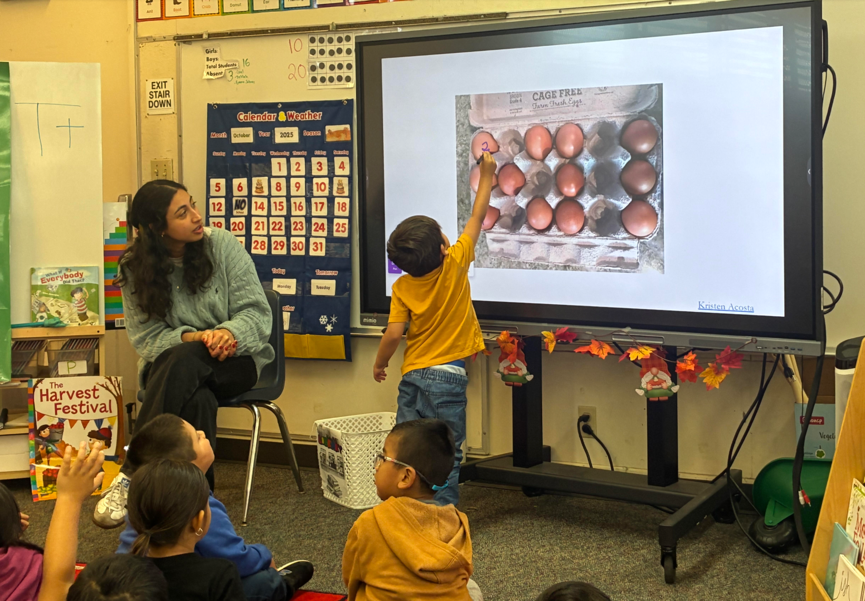
For the final image, Sophia shows the class this picture.
The boy in the photo comes up to the board and hesitates.
Sophia asks, “how many?” in Spanish.
This question invites the student to touch each egg as he counts to 12 in Spanish.
“How many eggs are missing?” Sophia asks as we gather our things and file out of the room.
Lessons Learned
We learned a lot from our visits to these teachers’ classrooms. We noticed that the visual image routine provided transitional kindergartners many opportunities to learn and practice some important counting concepts such as one-to-one correspondence, cardinality, and the stable order principle. While much of the counting that goes on in TK involves cubes or other realia, the visual images offer children a different context for counting. We learned that it can be challenging for some four-year-olds to count objects projected on a screen, so allowing students to come up to the screen to count can be helpful.
We also learned that these visual images engage very young children and motivate them to mathematize the world around them. The pictures in the slide deck and the questions that teachers asked prompted students to use language to describe not only quantities but everyday objects such as eggs, pumpkins, berries, and more.
Thank you, Morgan, Sierra, and Sophia for inviting us into your classrooms. Your patience, skill, and positivity were impressive. And thanks to all the students who made our visits enjoyable. We want to come back!