Making Sense of Fraction Multiplication

Rusty Bresser
When I was in sixth grade, I remember learning how to multiply fractions by multiplying across the tops and the bottoms. The problem 1/2 times 1/2 was easy! All I had to do was multiply the numerators and denominators (1 x 1 and 2 x 2) and presto! One-fourth. I recall doing pages and pages of these problems, getting the correct answers but not understanding anything about what it means to multiply fractions. For me, like many students, I didn’t have to do the thinking because the teacher did it for me.
Fraction multiplication can be deceivingly easy when all you’ve been taught are procedures you haven’t made sense of. In fact, many adults continue to have misconceptions about mathematics long after leaving school. For example, I was walking with a friend recently and asked, “Is the answer to 1/2 times 1/2 greater or less than 1/2?” He immediately answered, “Greater!” I asked him why he thought that, and he replied, “Because multiplication makes things bigger!”
Real Life to the Rescue
Knowing that multiplication operates differently with fractions than with whole numbers is part of having conceptual understanding. And being able to visualize what happens when we operate on fractions is part of that understanding.
I remember the first-time fraction multiplication made sense to me. I was reading an article by Math Transformations consultant Mary Ann Warrington (Mathematics Teaching in Middle School, NCTM, 1998). In the article, Mary Ann reflects on how she taught fraction multiplication by simply posing real life situations. She started by asking her students questions like, “If you had half of an apple pie and you ate half of it, how much did you eat?” Then she asked, “What’s half of a half? Or, what’s 1/2 times 1/2?” She began every problem as a real-life scenario that kids could relate to, then linked it to a math expression. The students thrived, and I thought it was brilliant (and still do).
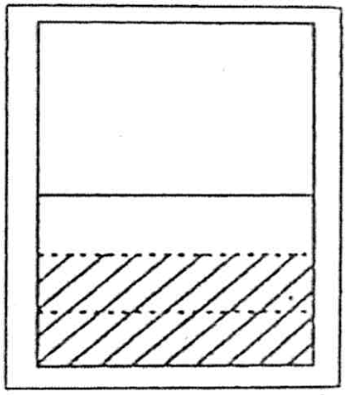
Another problem Mary Ann posed went like this: A half of a pound of jellybeans was in a container. Georgia and Emma ate 2/3 of the jellybeans in the container. How much did they eat? Before reading on, think about the problem, and draw a picture or model that might help.
Being able to visualize helped her students solve the problem, “What is 2/3 of 1/2?” And many solved it by drawing pictures like the one below. No one multiplied across the tops and bottoms.
Another Fraction Word Problem
The jellybean problem is a good one for multiplying fractions by fractions. Recipes are also interesting contexts for seeing if students can apply either addition or multiplication to a problem situation. My colleague, Karyn Conner, and I spent a day with three wonderful fifth grade teachers recently. We posed the following problem to their students.
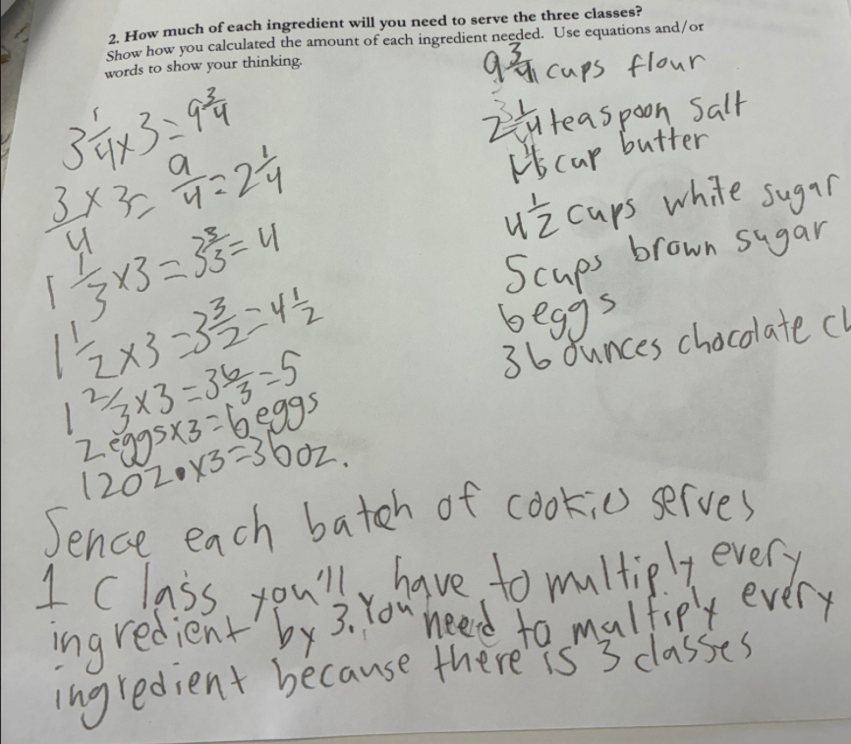
The 3 fifth grade classes are having a party, and you are baking cookies for all 3 classes. Each class has 30 students. You must provide one cookie for each student. How much of each ingredient will you need so that every student gets one cookie?

Many students applied multiplication when figuring the answer, just like the sample below.
Some used repeated addition like the following student.
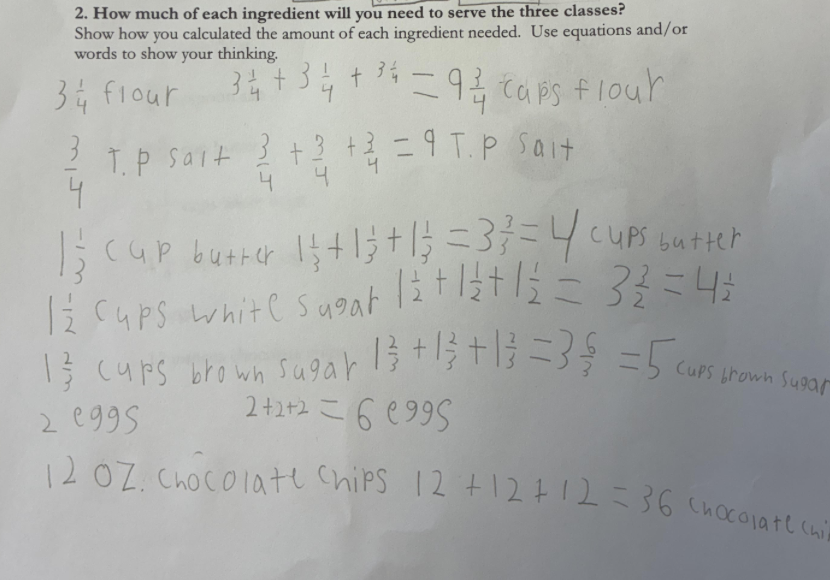
I like this problem for several reasons, most importantly because students can relate to the context. When we asked them if they’d ever baked cookies before, almost everyone’s hand raised. I also like this word problem because it’s naturally differentiated and accessible. Students can solve it using addition or multiplication, and if they only want to triple some of the ingredients rather than all of them, they can.
Making Sense Using Rectangles
Representing fraction multiplication using an area model supports conceptual understanding because the model
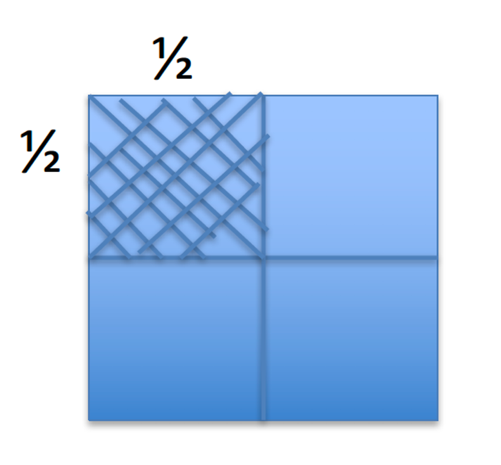
visually reveals the quantities. To model 1/2 x 1/2 for example, draw a square which represents the whole. Divide it in half vertically, then in half horizontally. Shade in the part that is one-half of a half of the rectangle (see my drawing below).
How about 1/2 x 2/3? Draw a square, divide it in thirds vertically, then in half horizontally. Shade in 1/2 of the 2/3rds.
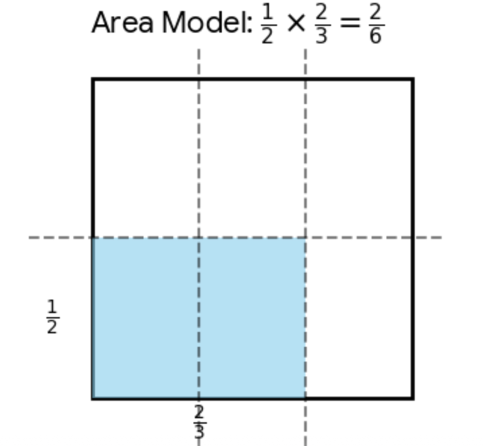
In the drawing, I can easily see where the 2 out of 6 is and why multiplying the numerators and denominators gets me to 2/6. By multiplying the denominators, you find the size of the new smaller pieces (sixths), and by multiplying the numerators, you find out how many sixths there are in a half of 2/3. This area model goes a long way in helping fifth graders understand multiplying fractions by fractions. In fact, using rectangles to find the product when multiplying fractions is a standard for fifth grade.
Making Sense Using Fraction Strips
Area models can be powerful visuals, but linear models also help students make sense of fraction multiplication. One of our favorites is engaging students in making fraction kits. First, have students make their own kit (see directions for making the kits in our blog post about fraction division here). Here’s what the finished kit looks like (you can also make a kit for thirds, sixths, and twelfths):
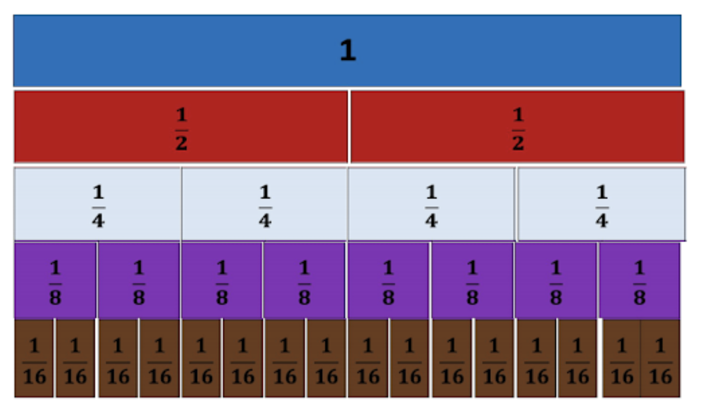
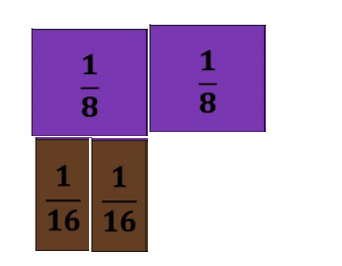
Once students build their kits and have had lots of experience noticing fraction relationships, comparing and ordering fractions, and adding and subtracting them, pose some fraction multiplication problems. Students can use their kits to model and explain their thinking to a partner. For 1/2 of 2/8, a student can use the strips to model what the problem looks like and figure the answer:
Other problems to pose:
- What is 1/2 of 1 whole?
- What is 1/2 of 4/8?
- What is 1/4 of 1/2?
- What is 1/2 of 1/8?
- What is 1/2 of 3/4?
- What is 1/4 of 1 whole?
- What is 2 groups of 3/8?
- 4 groups of 1/16 = 2 groups of 1/8…True or False?
Fraction strips help third, fourth, and fifth graders visualize fractions, enabling them to bring abstract ideas to life.
Making Sense Using True or False Statements
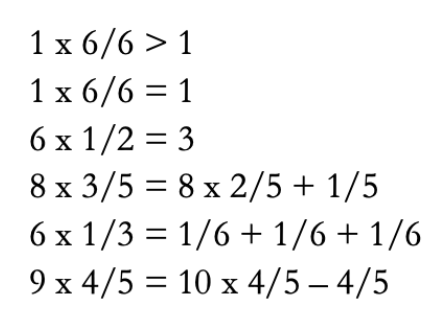
True or False Statements is a warm-up activity that reveals a lot about what students know about fraction multiplication, and it requires learners to consider what it means when we multiply with fractions. Here’s how it works. You show the class a statement such as 1 x 1/6 < 1. Ask them if they think it’s true or false. Give them some time to think, have them share their thinking with a partner, and then field a few ideas from the class. It’s a great way to engage students in argumentation. Here are a few more statements that you can share:
Sense-Making is Key
In her article, Mary Ann Warrington reflects about traditional instruction, saying that it’s, “based on the assumption that children must internalize in ready-made form the results of centuries of construction by adult mathematicians.” She argues that children must be allowed to make sense of mathematics, not just memorize procedures without understanding them. And, if we allow children to engage in sense-making, “they will do so with depth, pleasure, and confidence.”
Making sense of mathematics enables students to apply knowledge to new problems. It fosters engagement, critical thinking, and confidence, “turning math into a ‘figure-out-able’ subject rather than a set of arbitrary rules (NCTM).”
We hope the ideas shared in this post help you as you help your students make sense of fraction multiplication.