Six Dinner Sid: Bringing Multiplication to Life in Grades 2, 3, & 4

Rusty Bresser
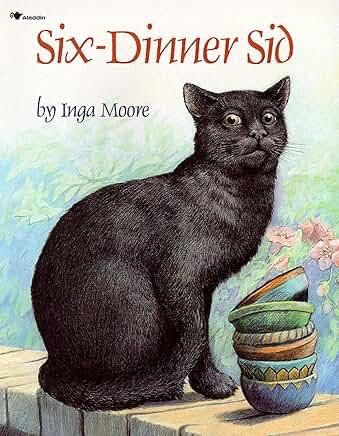 One of my favorite lessons starts with a cat named Sid who lives in a house on Aristotle Street. But he also lives at five other houses on the same street, so he can eat six dinners a day! He is a sneaky cat who gets away with his big secret until one day he comes down with a cold and must go to the vet. The vet discovers his secret and shares the news with all the neighbors, who aren’t happy. Things look bleak until Sid decides to move to Pythagoras Place where the neighbors don’t mind that Sid likes his six dinners a day.
Children love this story by Inga Moore (find the book here, but we recommend getting one for your library), and it’s a perfect springboard to a math problem: If Sid eats six dinners a day, how many dinners does he eat in one week? Students are motivated by problems that they care about, and they certainly care about sneaky Sid. I’ve taught this lesson in many classrooms, and I’m always impressed by how much mileage we can get out of just one lesson. In this post, we’ll explore Six Dinner Sid and its many possibilities.
Bringing Meaning to 7 x 6
One thing I like about Six Dinner Sid as a context for doing math is that the story provides meaning to a tricky math fact. Yes, we want children to have the answer at their fingertips, but we also want them to develop fluency when operating on numbers. For more ideas about computational fluency, see our post about basic math facts here.
At the heart of fluency is understanding the underlying mathematical concepts and being able to choose the most appropriate strategy or operation for a given problem. For example, finding the answer to 7 x 6 quickly is important and efficient, but fluency also requires the student to understand what multiplication means. In this case, 7 groups of 6 can mean seven groups of six dinners. Understanding the concept allows the learner to use this knowledge to solve 7 x 6 if they don’t know it by memory. For example, they can use what they know (7 x 5) and then add another seven to get to forty-two (7 x 5 is 35 and 35 plus another 7 is 42).
What Will Students Do? What Do They Know?
Another thing I like about the Six Dinner Sid lesson is that it piques my curiosity (and students’ curiosity) about what students will do and how they’ll showcase their knowledge when posed with the problem. This curiosity brings joy to my teaching, something I try to maintain whenever I teach a math lesson.
For example, I wonder…
- Will students be able to create models (pictures and/or equations) to show their understanding?
- Will students show that they know what the numbers mean? For example, what do the 7 and the 6 stand for? What does the 42 represent? What story is the equation 7 x 6 telling us?
- Will they be accurate when doing the computation?
- What operation will they use? For example, will they demonstrate additive thinking by repeatedly adding a fixed amount (6 + 6 + 6 + 6 + 6 + 6) or will they apply multiplication to demonstrate efficiency? Or something I haven’t thought of!
- Will students explain their thinking with words, and will their explanation or argument help me understand how they solved the problem? Will they use math language in their writing?
In the Classroom with Third Graders
The following student work samples come from a variety of third and fourth grade classrooms. In every class, I launch the lesson with a reading of Six Dinner Sid. Children’s literature draws the students into a context and connects mathematics to the world around them.
When I finish the book, I ask the question: If Sid eats six dinners a day, how many dinners will he eat in a week? I then ask the class to think about it and share with a partner how they might get started. Then I give them a blank piece of paper and they go to work.
For this lesson, I don’t provide any scaffolds other than a sentence frame:
Sid ate ___ dinners in a week. I know this because __________.
I’m interested in students’ problem-solving skills. By that I mean, how do they make sense of the problem and what is their pathway to an answer?
Examining Student Work Samples
We can learn a lot about students’ math thinking from pouring over their work samples, and we can have fun in the process! As well, students can add to their repertoire of strategies and gain insight into how to write about their thinking when we share examples with them.
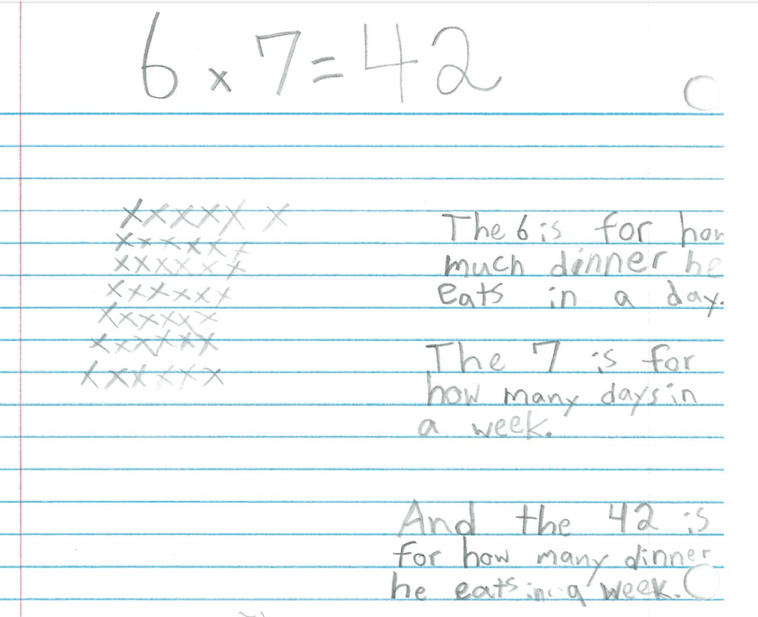
Let’s look at a few student work samples to see the different ways they think. This student shows that they know what the numbers mean and uses an array as a model. They clearly describe their knowledge in writing. One question I’d ask would be why 6 x 7 rather than 7 x 6? Which one tells Sid’s story? Or does it matter?
Eleanor Duckworth, education professor at Harvard and student of Piaget says,“Getting people to think about what they think, and asking them questions about it, is the best way I know how to teach.” In other words, engaging students in metacognition through our questions can enhance their learning and help them assess their own thinking.
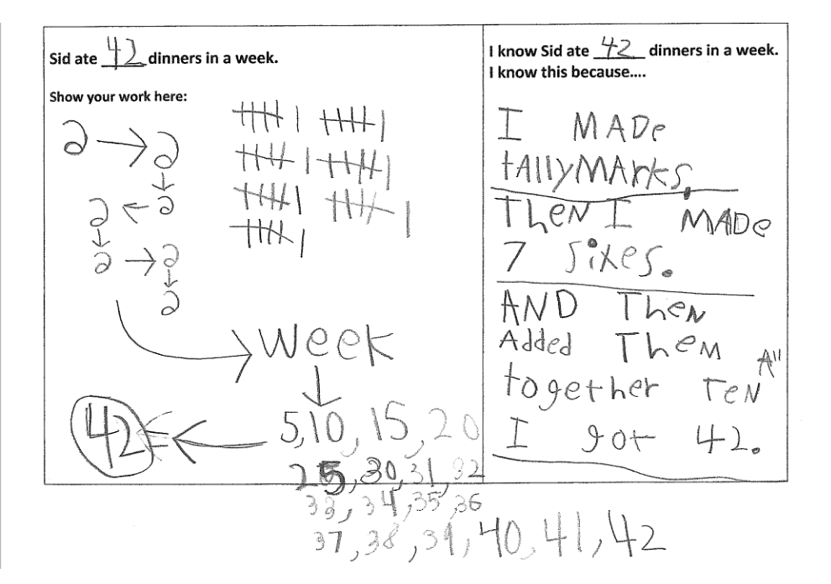
This student used tally marks, counting by fives (it was easier for him) and then adding on the remaining seven tallies to get to 42. The evidence he provides is logical and sequential.
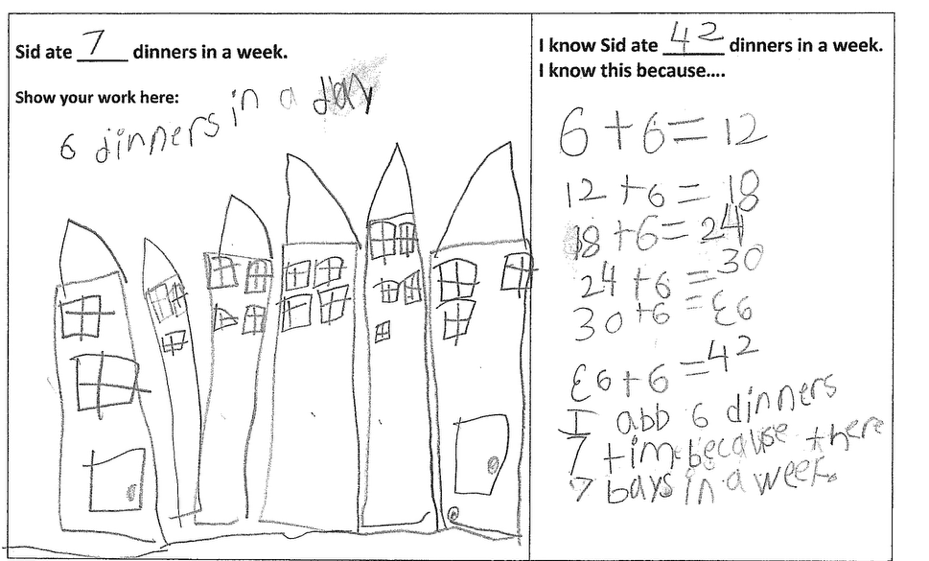
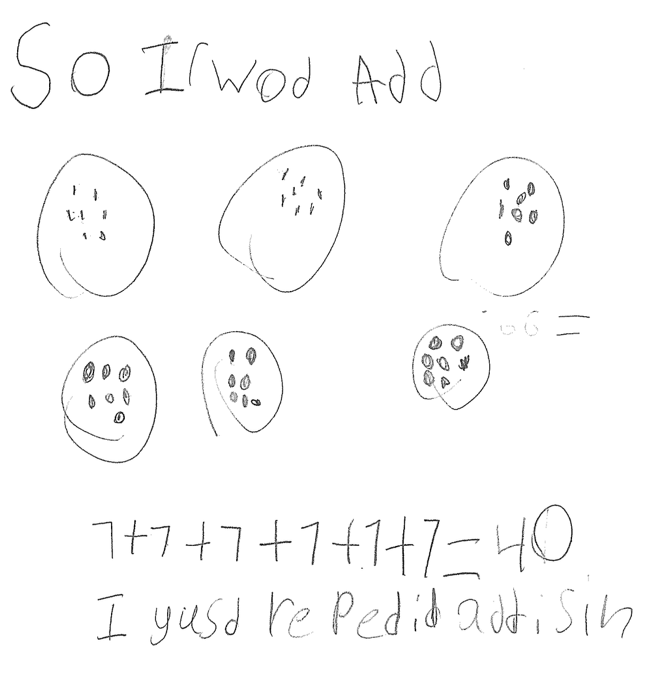
This student kept a running total, adding six dinners until she got to forty-two. Her writing describes multiplication in words, “I added 6 dinners seven times because there are seven days in a week.”
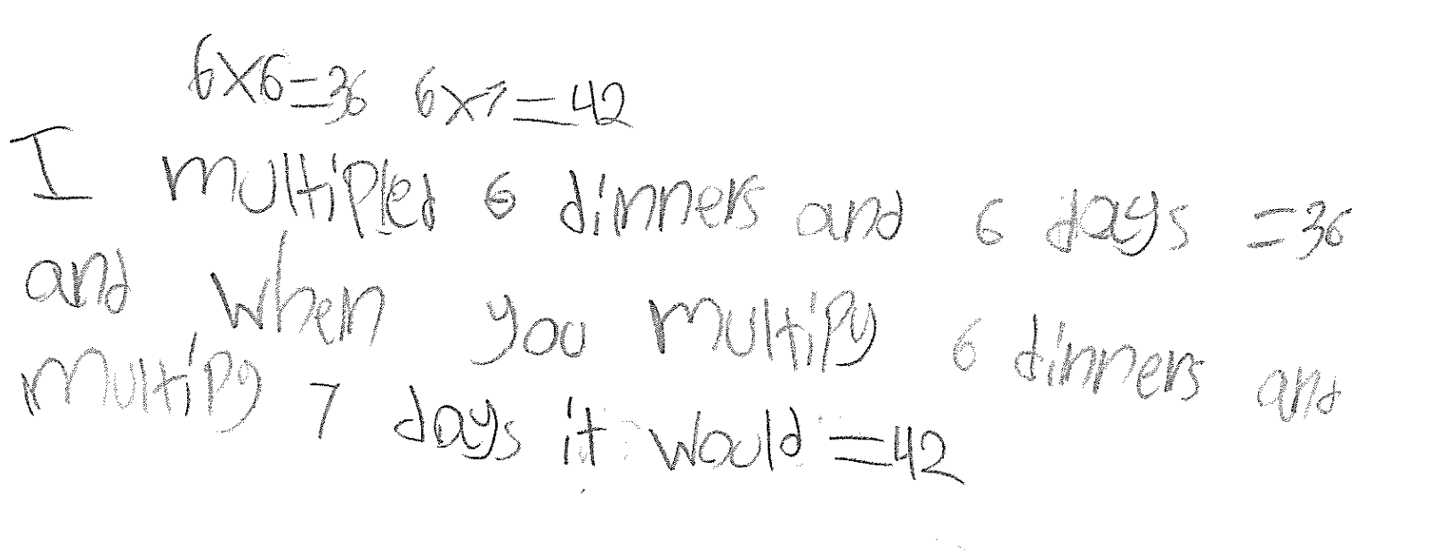
This student uses what he knows (6 x 6) and then adds another 6 dinners to get to 42.
 Even when we notice that a student struggles, we can still look for and appreciate their strengths and then guide them to their next steps. We can see that this student’s accuracy is off (but close), and their representation of the problem is six groups of seven rather than seven groups of six. But they can represent the problem using a set model and an equation, and they let us know in writing that they used repeated addition. This isn’t a “low” student, they are just on their own learning trajectory.
Asking clarifying questions like, “How many dinners did Sid eat each day? Show me in your equation and picture. How many days are in one week? Show me in your equation and picture.” may prompt the student to re-think and move forward.
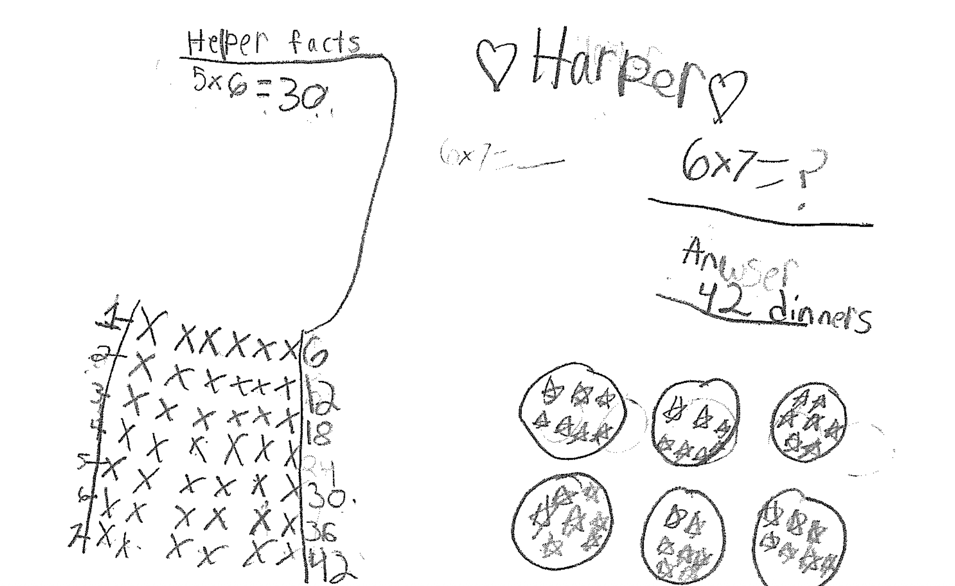
This student used “helper facts” as a pathway to the answer. She also used several models, including an equation, sets, and an array.
Posing a Challenge
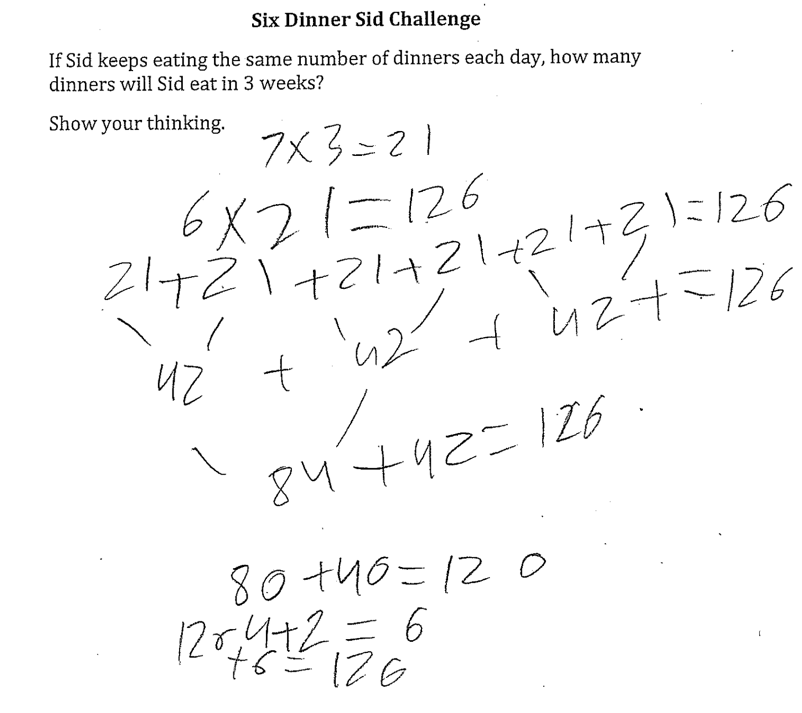
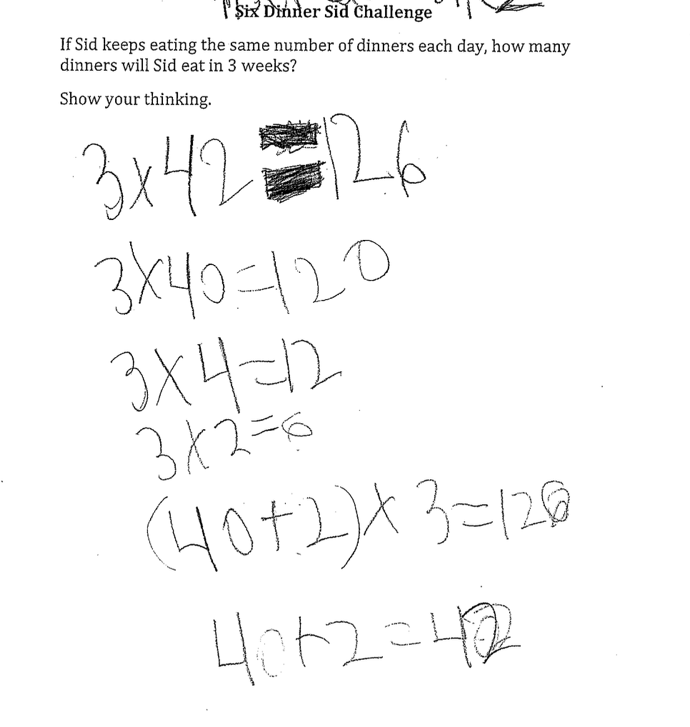
A nice challenge for third and fourth graders: If Sid keeps eating the same number of dinners each day, how many dinners will Sid eat in 3 weeks?
This fourth grader does a nice job of providing a window into her thinking by showing how she used multiplication and addition. I’d like to ask her what the numbers mean in her explanation and encourage her to provide references from the problem context.
Here, a student demonstrates how he can break numbers apart, making use of place value to arrive at the answer. I’m curious what the numbers stand for and would encourage the student to use labels or a written explanation in his work
Bringing Mathematics to Life Through Literature
I was first introduced to the idea of using children’s literature from Marilyn Burns who writes, “I’ve found that children’s books are extremely effective tools for teaching mathematics. They can spark students’ math imaginations in ways that textbooks don’t. Connecting math through literature can boost confidence for children who love books but are wary of math. And students who already love math can learn to appreciate stories in an entirely new way.” (Marilyn Burns Math)
We hope you introduce Sid the cat to your students. They’ll love the book and the math that comes with it!