The Power of Patterns: Math Activities & Warm-Ups for Grades TK-6

Rusty Bresser
Math educator Mary Barrotta-Lorton once said that the power of pattern is the ability to predict beyond physical evidence. In other words, if you understand how a pattern works or functions, you can make predictions without having to build or draw it.
Let’s say that you want to have a party and you have square banquet tables. With one table you can seat 4 people. Pushing together 2 tables seats 6 people, and pushing together 3 tables seats 8.

If you understand how the pattern works, you can calculate how many tables you’d need to seat 20 people (or 100 people!) without drawing or building every single table. Try it out!
Understanding how patterns work is important in many ways. For example, it allows the learner to make predictions, recognizing how a sequence grows and changes, helping them forecast future values.
Knowing how patterns function allows learners to make generalizations, looking past individual numbers or objects and identifying the underlying rule that governs them: “I know that I’ll need 9 tables to seat 20 people because nine can sit on one side, nine on the other, and one at either end—double the number of seats on one side and add 2.” This kind of reasoning can lead students to figure out the number of tables needed for any number of people, and it might even guide older students to a formula. Learning how patterns work, whether they repeat or grow, is fundamental to algebraic thinking.
Patterns that Repeat
A nice math warm-up for any grade TK-6 is called Hide the Pattern. Here’s how it works (access slide here).
- For very young students, create a repeating pattern, hide it from them, and then tell them, “I am going to show you my pattern for just a minute, then you are going to go make it.”

2. Let students build the pattern using Pattern Blocks.
3. Ask them if they need another peek at the pattern.
4. Show the pattern again and ask, “How did you remember the pattern?”
5. Allow students to continue building the pattern on their own or together with you.
For older students, asking questions like, “What stays the same in the pattern?” helps them identify the period of the pattern. The core or the ‘period of the pattern’ is the length of the smallest repeating unit before the sequence or cycle begins to repeat itself. Asking questions like, “When does the pattern start and end? When will it start repeating again?” can help students begin to make predictions.
Being able to identify the period of a pattern allows students to extend beyond the visible. For example, ask students to predict what the 10th shape looks like and notice how they reason.
- Do they have to build the pattern with blocks?
- Do they chant, “Green, green, orange…green, green, orange,” all the while counting on their fingers to 10?
- Do they begin to generalize by reasoning that there are three blocks in the pattern, the pattern ends with an orange square, so the ninth block is an orange square, making the tenth a green triangle.
Mystery Tile Pattern
This math warm-up is similar to Hide the Pattern. In this activity (access slide here), the teacher shows the class the first tile in the pattern and asks, “What do you predict will come next?” Students invariably predict all sorts of things: different colored blocks, shapes, and so on. There’s not enough information yet about the pattern to be able to predict, and this is what we want students to realize.

Next, the teacher reveals the next tile and then the next, each time asking students to predict what the next tile will look like:
 The teacher continues to reveal more tiles until the class identifies the period or core of the pattern, which is made up of 5 tiles: red-red-yellow-blue-and green.

At this point, the teacher might ask students to make predictions about tiles they can’t see further down the ‘train’. For example, she might ask, “If there are 20 tiles in the pattern train, what does the 20th tile look like?” This question provides students the opportunity to make use of what they know to make generalizations.
What do YOU think the 20th tile looks like? The 30th? How would you explain how you know?
Patterns that Grow
Growing patterns—sequences that change or increase by a predictable rule at each step are essential in elementary mathematics because they build the foundation for higher-level thinking. Following is a pattern that grows (access slide here). How do you see it growing? What is changing? What is staying the same? How would you describe it?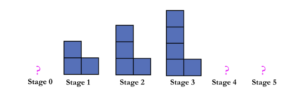 I like this pattern because in some ways it is accessible to very young children and to older students. Fourth and fifth graders, for example, can reason about and predict how many squares are in the tenth stage or even in the hundredth stage, or wrestle with figuring out what Stage 0 looks like. Younger students can build the pattern and make guesses about what comes next in stage 4 or beyond.
Another thing I like about this growing pattern is that there are different ways to ‘see’ what’s constant. How do you see it?
Do you see this as the core that remains constant in subsequent stages (see below)?

Or do you see this (see below) as the core that stays the same in subsequent stages?

Knowing how the pattern grows, what’s staying the same (the core) and what’s changing helps us make predictions about subsequent stages. What’s your prediction for how many squares there are in the 5th stage? The 10th? The 100th? How would you describe it?
Growing Iguanas
One of my favorite growing patterns involves making iguanas with Pattern Blocks. Here’s how it works.
Start by showing the class what a newborn baby iguana looks like. Ask them what they notice and to describe it to a partner.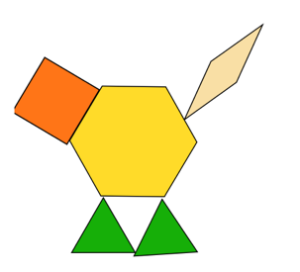
Next, show them a newborn next to a one-year-old iguana. Ask them what they notice, comparing the two iguanas: what’s the same? What’s different? 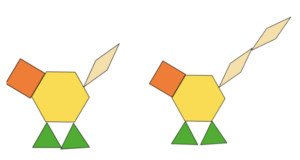
Next, show them what the iguana looks like at 2-years-old. What do they notice? What’s changing? What’s staying the same? Have them work with a partner and build the three iguanas, and then build a three-year-old.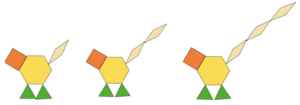
Finally, ask the students to predict what a ten-year-old iguana looks like without building it. Can they describe it? How do they know? Look for students to say something like, “I know that a ten-year-old iguana has fifteen blocks; one head, one body, two feet, and eleven pieces on the tail because the number of pieces on the tail is one more than its age.”
Another way to help students see how the pattern is growing is to make a table with the students. This three-column-table helps students see where the total number of blocks comes from. Asking the class what they notice and what the numbers mean helps them make sense of the growing pattern and make predictions for any age iguana.
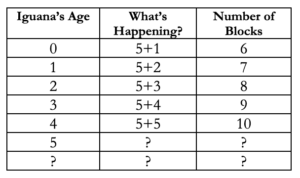
Growing Iguanas gives students experience building, comparing, extending, describing, and generalizing about growth patterns using different representations (blocks, equations, words, tables, and for older students, formulas). It gives students, especially multi-lingual learners, opportunities to describe and compare patterns. And the activity/warm-up is applicable in some way to any grade level.
The Power of Patterns
Patterns are everywhere in the world around us. Snowflakes and crystals, honeycombs, tiles on the ceiling of a classroom, fish scales, seasons, day and night, ocean tides, people’s behavior, and on and on. The ability to predict, beyond physical evidence, helps humans prepare for weather, avoid repeating mistakes, save time, learn new skills, read social cues, diagnose illness, and more.
In the short term, understanding and making use of patterns prepares elementary students for the world of algebra. And the standards, both TK Foundations and Common Core, include learning about patterns from transitional kindergarten, where 3 and 4-year-olds are encouraged to notice and describe patterns in their environment, to fifth grade where students are expected to analyze patterns and their relationships.
We hope you can use some of the ideas in this post in your classroom, and that the post gives you a new appreciation for the importance of teaching about patterns to your students.