Stacking La Croix: Exploring a Cognitively Complex Task with Fourth and Fifth Graders

Rusty Bresser

Above are two photos, one shows a stack of La Croix soda boxes, and the other gives you a view of the very top of the stack. What do you notice? What do you wonder? How many boxes of La Croix soda do you think there are in this stack? Take a moment and think about it.
Now, if you knew that in each box, there are 12 sodas, how would you go about figuring out how many La Croix sodas there are altogether in the stack? Take a few more moments and think about how you’d go about figuring the answer.
Complex Tasks are Challenging!
Complex math tasks require students to reason, make decisions, and explain their thinking. Cognitive complexity is the amount and type of thinking a math task asks students to do. It’s not about whether numbers are big or small. Typically, complex tasks are multi-stepped and engage students in problem solving and critical thinking.
When you were asked to think about the boxes and cans, you probably had to consider lots of things. How will I get started? How many boxes are in each layer? How many layers are in the whole stack? And what about those boxes in the middle of the stack? What operations might I use and why? And when you arrive at an answer, hopefully you reflected, “Is this reasonable?” Complex tasks are messy and are a lot more challenging than being given 9 x 6 x 12 to solve!
Planning the Lesson with Teachers
Recently, Math Transformations consultant Kathy Seckington and I worked with fourth and fifth grade teachers and their students in Vista, California. Our task, along with the teachers, was to plan the La Croix lesson, co-teach it in one of their classrooms, come back to reflect, adjust, analyze student work samples, and hopefully improve the lesson, and then teach it again in a different class.
Before the lessons, the teachers shared their observations and concerns about their students. They were all interested in exploring the following questions:
- How can we improve student engagement?
- What strategies might help students (including our multi-lingual learners) communicate their thinking orally and in writing?
- How can we help students develop their number sense?
- In what ways can we provide support while not stealing the productive struggle?
Planning for Student Engagement and Number Sense
Using familiar real-world contexts like the Le Croix problem engages students because they can make personal connections, which increases interest. When students see the photo of the stack of Le Croix boxes, you see familiar nods or hear questions like, “What are they?” They begin to wonder how many boxes there are and what’s inside of the boxes.
When we pose intriguing estimation questions like, “About how many boxes do you think there are in the stack?” students are immediately engaged and want to share their guesses. Estimating gives the students a stake in the results, and they are often curious about how their estimate compares with the actual answer. Estimation is the foundational building block of number sense, and asking students to make estimates during the Le Croix problem helps them develop this important skill.
The Le Croix task isn’t an easy one for most fourth and fifth graders. But given the right amount of challenge can help students think outside the box, affect their ability to persevere, deepen engagement, and bring joy to doing mathematics. When students have to struggle, it can positively affect their motivation.
Planning for Productive Struggle
While we want to provide scaffolds so that students don’t shut down, we also don’t want to give them too much help. We want them to struggle just enough for several reasons.
- The process requires students to use their own reasoning and background knowledge when solving problems, and it helps them develop conceptual understanding.
- When students are given more control over their own learning, even when it’s hard (but not too hard), they build confidence and become less dependent on the teacher.
- When given the chance to struggle, students start asking themselves questions, engaging in metacognition: What am I trying to figure out? What do I know already? What part might give me trouble?
- Struggle provides a window into students’ thinking and can increase a teacher’s awareness of the misconceptions a student may have, paving the way for future support.
As we planned, the teachers brainstormed things to say and ask so as not to steal the struggle.
-
- Where will you start?
- Explain how you got….
- What does that number represent?
- Help me understand your strategy.
- Show me how you figured it out.
- Let’s reread the question.
- What do you know so far?
- What numbers and operations will you use? Why?
- How can the photos of the La Croix stack help you?
Planning for Language Support
Because teachers were concerned about their students’ ability to communicate their math thinking, we brainstormed sentence stems and frames that might help. For example, when asking students to estimate how many boxes are in the stack of La Croix boxes, teachers planned to offer this frame:
I estimate that there are about ___ boxes. I think this because __________.
While students work to figure the total number of cans in the stack, teachers planned to offer the following frames and stems:
I think there are ____ cans altogether. I know this because ____________.
We know that _________, so _____________________.
First, ________. Next, _________. Then, _________. Finally, _____________.
In the Classroom with Fourth and Fifth Graders
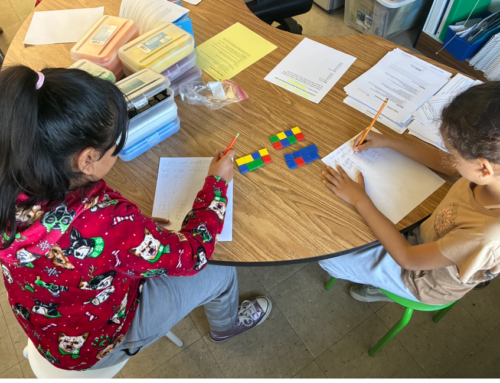
Teachers launched the task by showing the class the photo of the Le Croix stack, asking students what they noticed and wondered. They also asked students to estimate how many boxes there are in the stack. Many students counted nine layers of boxes and five boxes in each layer, multiplying 9 x 5 to get 45 boxes. But when teachers revealed a photo of the top layer (see the photo at the beginning of the post), there were sounds of wonder and surprise from the class—just the kind of engagement and curiosity that we were looking for. The surprise that there are actually six boxes per layer motivated students to re-visit their estimates and served as a solid starting point once they tackled the following problem.

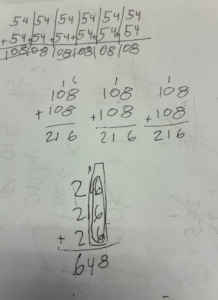
Students went about solving the problem in a variety of ways. This student (see below) added 54 twelve times to get a total of 648. I’d be interested in knowing whether the student knew what the numbers meant, and encourage them to include labels to strengthen their communication.
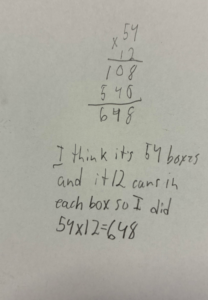
This student gives us a short but concise written explanation to accompany their calculation. I wonder how the student knew there were fifty-four boxes?
These two students worked together and provided quite a bit of evidence in their written explanation and in the models and labels they used. Notice that they explained their problem solving process, not just the steps in their calculations (which is evident in their area model and equation).

Differentiating the Task
Productive struggle happens when a learner is challenged just enough to have to puzzle through a problem, try different pathways, look for patterns, make mistakes, and start again as they try to make sense of whatever they are trying to figure out. Letting students struggle can be a good thing, but leaving students to flounder or experience anxiety to the point of shutting down—this is ‘unproductive struggle’.
We noticed that the La Croix problem was challenging for all of the students, which is good. But for a portion of the class, it was too challenging despite the support that teachers provided. In this case, differentiating the task while maintaining an appropriate amount of struggle is key. Teachers can do this in at least two different ways.
One way to differentiate is to change the number of cans per La Croix box. For example, a student might have to figure the total number of cans in the stack if each box contains 10 (or another number) cans rather than 12. Another way to adjust the task is to have a student find the total number of cans in only one, two, or three layers. This way, students are still engaging in problem solving and experiencing productive struggle but at a level that is appropriate for them.
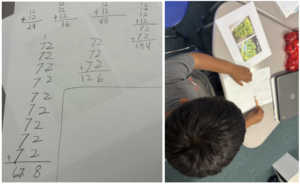
The student below initially struggled, and he needed lots of support getting started. For example, when I asked him how many cans there are in two boxes, he was able to create an equation (12 +12). I kept asking him, “What if you add one more box of cans?” until he figured out how many cans were in one layer. He then caught on and solved the problem independently, adding 72 nine times. While his answer is a little off the mark, the scaffolds provided allowed him to stay in the game.
Back to the Teachers’ Questions and Concerns
At the beginning of our days together with the fourth and fifth grade teachers, they shared their concerns and questions with us, and their questions were good ones! Their concerns are ones that really matter in math class, such as student engagement, communicating mathematical ideas, number sense, perseverance and productive struggle. One teacher lamented that many of her students, when faced with a challenge, shut down and just wait for someone to ‘do it for them.’ Her concern is not unusual.
Following are a few tips to help with engagement, communication, number sense development, and productive struggle.
- Rely less on the textbook to teach, and incorporate rich, cognitively complex tasks that include visuals that stimulate students’ curiosity.
- Ask students to estimate a lot! Don’t wait until the chapter in the textbook that includes estimation questions.
- Provide opportunities for students to pair up and talk with one another. Use scaffolds such as sentence stems and frames that support language production.
- Find tasks that can be easily and naturally differentiated.
- Offer support in the form of questions that don’t steal the struggle but that keep students in the game and that encourage independence.
- Encourage students to write about their problem-solving process! See our blog post about writing in math class here.
Interest, engagement, and motivation serve as the cognitive engine for elementary mathematics learning. While rote practice can produce short-term skill fluency, sustained conceptual understanding and problem solving relies heavily on these affective factors. We hope our tips are helpful, and we encourage you to try out tasks like the Le Croix problem with your students!
Special thanks to the teachers we worked with. Their ideas, questions, and willingness to take risks are appreciated. And thanks to their students for trying on a challenging task!