Dividing Candies: A Rich Task for Third and Fourth Graders

Rusty Bresser
If you had 24 candies, what are all the ways you could make equal groups? No remainders allowed! Take a moment and think about the question.
As you tackled the task, did you use a systematic strategy or did you go about solving it randomly? Were you able to find all of the ways, and if so, how do you know that you found them all?
Did you think about the different factors that make 24?
Did you think about the problem as a series of partitive division questions: “Can I make 2 equal groups? Yes, 12 candies each. Can I make 3 equal groups? Yes, 8 candies in each group. Or, did you think about it as a series of quotative division questions: “Can I make equal groups of 2? Yes, 12 groups. Can I make equal groups of 3? Yes, 8 groups.”
One thing I like about the Dividing Candies problem is that the context can be either partitive or quotative, it just depends on how one interprets it. And adults and students approach the task from multiple perspectives, which is one of the features of a rich math task.
What Makes a Math Task Rich?
Mathematics leaders Linda Dacey and Rebeka Eston (Dacey & Eston, Math Solutions Publications, 1999) remind us that a rich math task:
- is contextualized,
- surfaces significant mathematical ideas,
- offers an appropriate challenge for everyone,
- includes opportunities to use language to learn, and
- is open-ended and allows for multiple perspectives.
When I recently visited my friend and colleague Lily Murphy’s third and fourth grade combination class to try out Dividing Candies, I found that the task not only included all of the features of a rich math task, but it was also motivating, engaging, and relatable to Lila’s students. In this post, we’ll explore how the lesson went and offer tips for implementation.
In the Classroom with Third and Fourth Graders
To introduce Dividing Candies (access lesson plan here), I held up a plastic bag with tiles inside. “I have some tiles in this plastic bag. We’ll pretend that they are candies. How many candies do you think are in the bag? Think, then whisper your estimate with someone sitting next to you.”
This estimation question served to pique students’ interest, and I noticed that it helped get their attention right from the start. Once I told the class that there were in fact 24 candies in the bag, I asked my next math question.
“If I wanted to put the 24 candies into 2 equal groups, how many would be in each group and would there be any leftovers? Think, then talk with a partner and share your thoughts.”
Following the partner talk, I elicited ideas from a few students. Everyone agreed that in each group there would be twelve candies and no leftovers, but their reasoning was different.
“Because 12 x 2 is 24.”
“Because 24 divided by 2 is 12.”
“Because 12 plus 12 is 24.”
My question and the students’ responses surfaced the idea that there are different ways to think about a division situation, and that there are relationships between operations. Asking questions like, “How do you know that?” can uncover important math ideas that help to develop students’ content knowledge.
Next, I posed the guiding question that students would seek to answer: “How many different equal groups can we make with 24 candies? No leftovers!”
I offered this sentence frame to help students make claims:
We can make ___ groups of ___.
We practiced using the frame using the 24 candies in 2 groups problem:
We can make 2 groups of 24.
Exploring
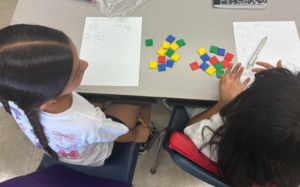
Once partners had one bag of 24 candies to share and a blank piece of white paper each to record their findings, the class dove into the task with enthusiasm. And they went about solving the problem in a variety of ways. For example, these two girls (see below) modeled dividing 24 candies into 2 groups, and then drew a diagram to represent their physical model.
These students (see below) were recording their discovery that you can divide 24 candies into 3 groups of 8 without any leftovers. The color tiles made it easy for them to create rectangular arrays.
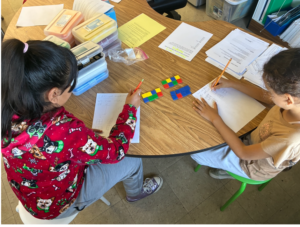
These girls (see below) started by putting 3 candies in a group and then continued to see how many groups they could make.
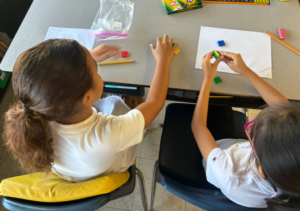
Students’ work samples also revealed a variety of thinking about dividing candies. These two students (see below) used arrays to model the different ways to divide 24 candies. They also used multiplication, addition, and division equations to model as well, making use of the sentence frame to make their claims.
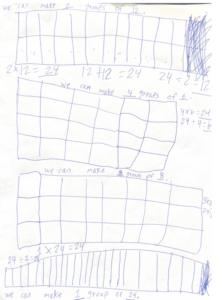
Notice how this pair of students (see below) found seven out of the eight different ways to divide 24 candies. For many students, finding all of the different ways was a real challenge.
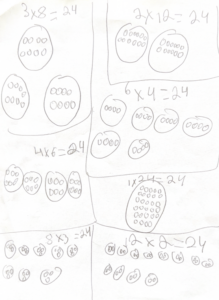
Some students, like the pair below, explored the different factor pairs (or 3 factors) that make 24 candies.
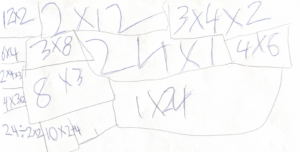
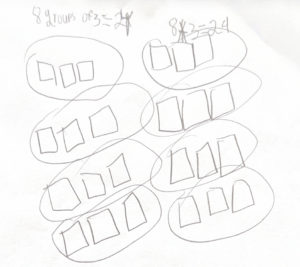
And for a few, it was a struggle getting started. The boy I was working with was finally successful in finding 8 groups of 3 candies; he used words, a diagram, and an equation to model. The low floor, high ceiling nature of the task allowed him to both experience a challenge and a success.
Summarizing the Lesson
When students seemed finished, Lila called them back to the rug to reflect on what they’d learned. She started by eliciting the various ways students found to divide 24 candies into equal groups and recorded their discoveries on chart paper. As students shared their thinking, Lila explicitly highlighted important mathematical ideas when they popped up.
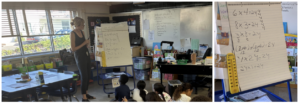
For example, Lila pointed out the 8 x 3 and 3 x 8 and asked the class what they noticed and what the equations stood for. Students recognized that both have the same product. “Yes,” Lila agreed. “With the commutative property of multiplication, the products are the same, but do they look the same with the candies (8 groups of 3 vs. 3 groups of 8)?
And when students shared 1 x 24 and 24 x 1, Lila again asked the students what they noticed and highlighted both the commutative and identity property of multiplication, modeling academic language.
One pair of students first divided the candies in half, and then each created 2 groups of 6. Lila modeled the distributive property by recording (2 x 6) + (2 x 6) = 24 (see the chart above).
Throughout the lesson summary, Lila consistently asked the class what the numbers in the equations meant, connecting back to the lesson context. “What does the 6 mean in 6 x 4? What is the multiplication sign saying (groups of)?
And when she noticed that all of the equations that she gathered from the class focused only on multiplication, Lila pivoted and asked the students to think about how they might represent the candy groups with division equations.
Answering the Big Question
Finding all the different ways to make equal groups with 24 candies was a big task for most of Lila’s students. I think if we had had more time, more students would have been able to meet the challenge. But it begs the question, what are some questions teachers might ask to help students if they’re stuck, or don’t have a systematic way of recording.? What questions can we ask that don’t steal the productive struggle?
For example, we might ask…
- Can you show me one way you’ve grouped the candies so far?
- How are you going to keep track of the ways you’ve already tried?
- As you make more groups, what happens to the candies in each group?
- If you found that 3 groups of 8 works, does that help you figure out another way instantly?
- How do you know for certain that there’s not another hidden combination?
- Is there a way that you could organize your paper to help you know that you’ve found all the ways?
Increasing the Potential for Learning
Jo Boaler in her book Mathematical Mindsets offers five suggestions that align with the features of rich math tasks and increase the potential for learning.
- Open up the task so that there are multiple methods, pathways, and representations.
- Include inquiry opportunities by asking the question or posing the problem before teaching the method.
- Add a visual component and ask students how they see the mathematics.
- Extend the task to provide a lower floor and higher ceiling.
- Ask students to convince and reason and be skeptical.
We hope you try out Dividing Candies, and we thank Lila and her students for always inviting us into her wonderful classroom.