Counting Buttons in Transitional Kindergarten: Exploring A Cognitively Complex Performance Task

Rusty Bresser
In our recent post about productive struggle (access here), we discussed what makes a task cognitively complex, noting that cognitive complexity is the amount and type of thinking a math task asks students to do. It’s not just about whether numbers are big or small. Cognitively demanding tasks require students to reason, think critically, make decisions, and explain and justify their math thinking. These tasks engage students in analysis, flexible thinking, exploring concepts and relationships, visualizing, and generating and defending claims.
But what makes a task cognitively complex for three and four-year olds? Let’s take counting for example. Learning to count and everything that it entails is complex for young children because counting requires them to integrate multiple distinct cognitive, spatial, and linguistic demands simultaneously. A counting task for transitional kindergartners requires them to apply and engage with the following concepts:
- One-to-One Correspondence: Assigning one and only one number name to each object being counted
- Stable Order Principle: Reciting number words in a fixed, repeatable sequence (e.g. 1,2,3,4…) rather than random order
- Cardinality: Understanding that the final number counted represents the total quantity of objects in that group
- Order Irrelevance Principle: Knowing that the order or direction in which items are counted does not change the final total
- Abstraction Principle: Ability to count any collection of objects, whether they are identical, different shapes, sizes, or color, or whether they are sounds (claps or drumbeats)
Counting Buttons as a Performance Task
Linda Darling-Hammond of the Learning Policy Institute says, “Performance tasks enable teachers to gather evidence not just about what a student knows but also what he/she/they can do with that knowledge.” Essentially, performance tasks tell us how students apply their knowledge to solve problems, and they are often situated in real life contexts, for example, counting buttons!
Recently, Math Transformations consultant Amber Tracy and I worked with three transitional kindergarten teachers in Vista, California, implementing a performance task with their students. The task works like this:
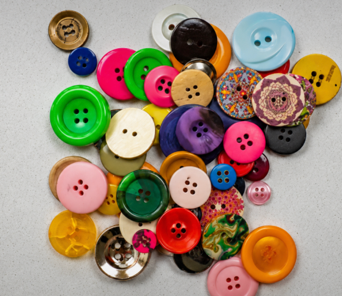
- Sit down with one student, and pour onto a tabletop a collection of 54 buttons.
- Ask the student, “What do you notice?” Listen while the student describes what they see.
- Ask the student, “Can you help me count the buttons?”
- Observe and take note as the student counts the buttons.
The task takes about five minutes to complete, which is important since TK teachers are busy people keeping very young students engaged and on task while they interview one student!
Why So Many Buttons?
Fifty-ish buttons might sound like a lot for a three or four-year-old, but starting with an amount that we know is probably too much has its benefits. For example, a large quantity of buttons provides the teacher with the opportunity to see how the student tackles the problem of counting so many buttons.
What will they do? Will they move one button at a time away from the pile? Will they try to count them by touching each one? How high will they count? The biggest benefit to placing a large quantity of buttons for the child to count is that it raises expectations. Often, teachers walk away from an interview surprised at what their student can do!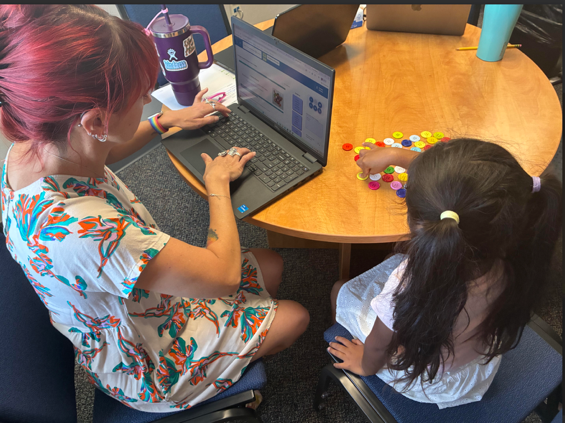
As we observed teachers interview their students, we noticed that if students struggled with counting a large number of buttons, the teacher would take away some, leaving the student with a more manageable number. This often revealed a lot about a student’s counting abilities. For example, if a student failed to utilize one-to-one correspondence trying to count 54 buttons, they might be able to show 1:1 with a smaller number.
As well, students were often able to demonstrate cardinality (the final number counted represents the total quantity of objects in that group) with a smaller quantity where they might not be able to with so many buttons to count. The questions teachers asked were important. For example, once a student finished their count, teachers would ask, “So, how many buttons are there?” If a student re-counted, it signaled the possibility that they hadn’t constructed the idea of cardinality. But if they immediately responded, “There’s fifteen!” then it signaled that they knew that the last number they counted represented the entire collection of buttons.
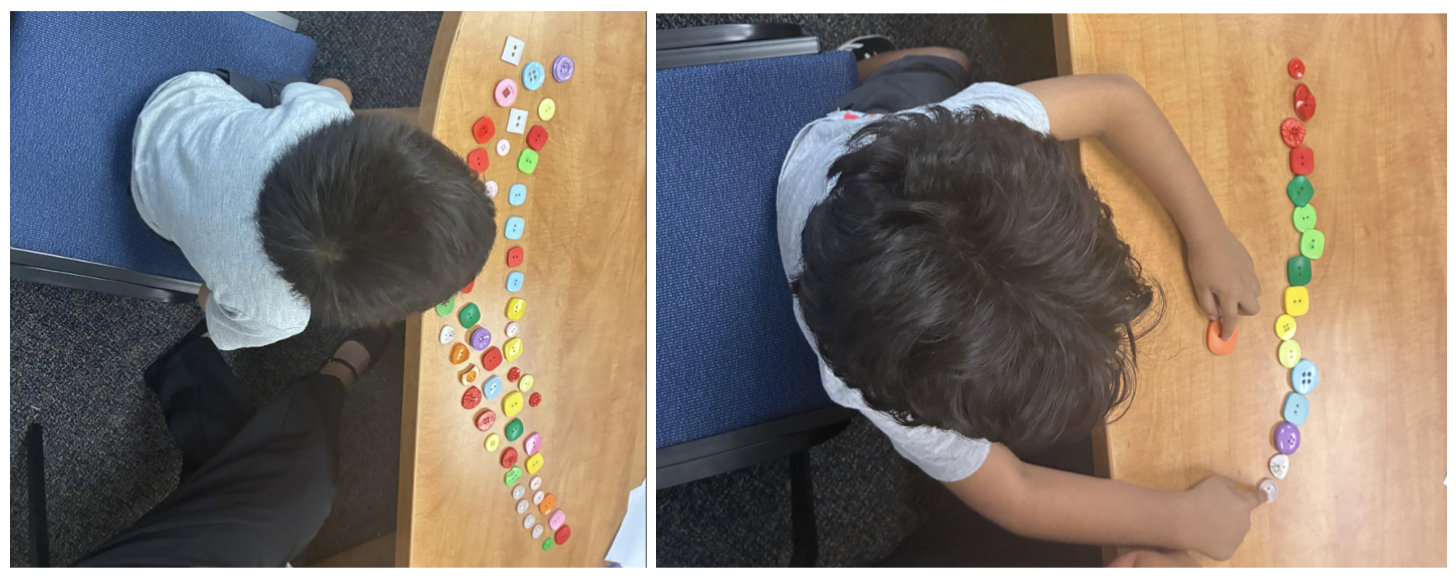
Notice the two students in the photos below. Both organized their collection in different ways, making it easier for them to count the buttons and demonstrate the application of important counting concepts.
Rote Counting vs. Rational or True Counting
As the teachers observed their students in the interviews, they were looking for how the students counted with conceptual understanding (True Counting) rather than by rote. There’s a difference between the two.
- Rote Counting involves memorizing words, while True Counting involves the meaning and value of numbers.
- With Rote Counting, students recite the count like a song, “1, 2, 3, 4…” whereas with True Counting, a child counts five apples and knows there are five.
- With Rote Counting, a child uses auditory memory and sequencing, while with True Counting, a child applies one-to-one correspondence and cardinality.
Using the Uncover Math Application
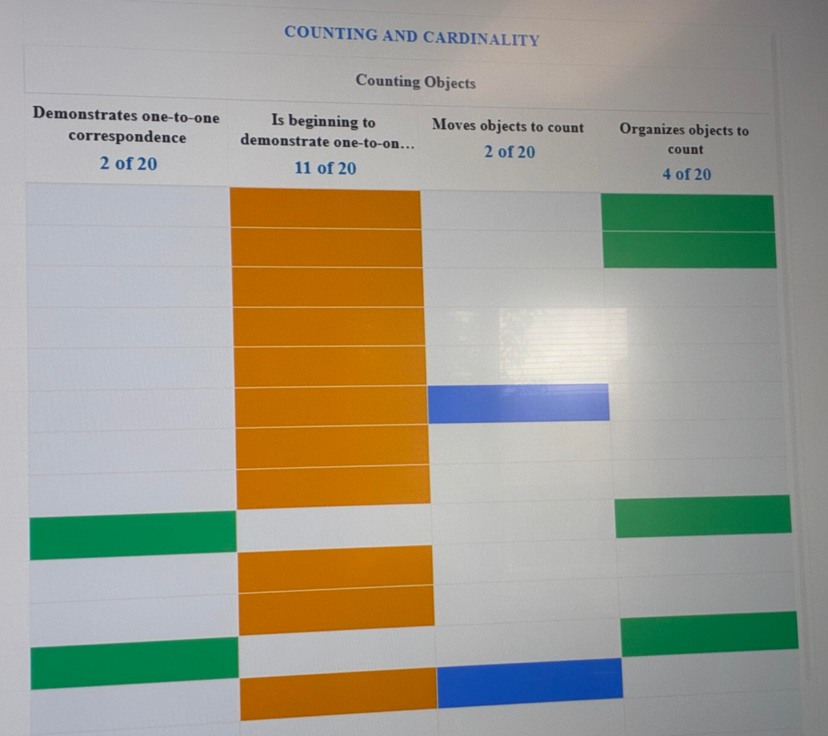
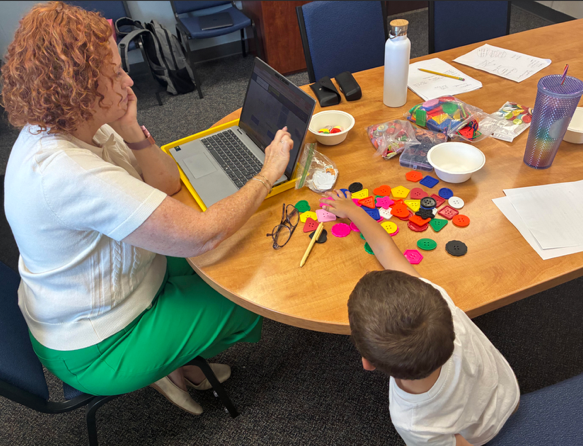 While the task is simple to implement, keeping track of what you observe as a student counts can be tricky. To help keep track, the teachers used the Math Transformations Uncover Math application on their computers. Using the app (for information about Uncover Math, use this link), teachers click buttons that keep track of a student’s way of thinking as they solve the problem of counting a collection of buttons, as well as their accuracy while counting.
For example, a teacher could note, by a click of a button, whether a student moves the buttons to count, organizes the buttons to count, and shows some or consistently demonstrates one-to-one correspondence. As well, a teacher can note how many buttons a student can accurately count (True Counting). The focus is on collecting data about what a student CAN do.
Using Uncover Math allows a teacher to view in a report how their class is doing at any point in the year (see an example of a report below). This information can serve to guide instructional next steps.
Now What? Next Steps
Performance tasks can yield valuable information about what students can do and their areas for growth. The button task can inform teachers about their students’ counting strengths, and guide next steps.
- How can I use this information as I decide how many items to put in my counting collection bags?
- How can I use what I’ve learned about students’ counting skills to inform what questions I’ll ask?
- What small instructional groups can I form from analyzing the performance task data?
- What counting activities and games might I offer students based on what I’ve discovered about their counting abilities?
Activities and Games for Counting Practice
- Visual Image Slide Deck – The slide deck includes visual images from the world that students can use to quantify, describe, measure, compare, and wonder when shown an image.
- The Three Tower Game – The Three Tower Game is where students roll a die and build a tower with cubes that matches the number on the die. They build three cube towers and then count how many cubes altogether.
- Tower Power – Tower Power is a game where students take turns adding blocks to a tower until it falls down. After it falls, they count to see how many blocks they used.
- Counting Collections – Students count a collection of objects and then record on paper the total and how they counted.
What We Learned from Counting Buttons
Jo Boaler says that performance tasks engage students in real problem solving, moving beyond rote memorization to deeper understanding. These tasks, she notes, make math more relevant and interesting but also develop essential skills. What we found when working with transitional kindergartners confirms what Boaler asserts. The button task was definitely engaging and interesting to students. And the assessment focused on essential counting skills, surfacing what students can do and informing teachers’ next steps.
There were surprises! Teachers observed the power of asking multi-lingual students to count in their native language, revealing strengths that were previously hidden. Teachers found that if they gave students more time to explore with the buttons, the more strengths emerged. Most importantly, the TK teachers discovered that more students displayed one-to-one correspondence than they had previously thought. They also noticed areas for growth, observing when students’ stable order broke down (especially when counting numbers in the teens).
The Value of One-On-One Interviews
Teachers, for good reason, worry about the time it takes to do individual interviews and the effort it requires to make sure the rest of the class is engaged in meaningful, independent work. But, the time and effort are worth it. We do individual interviews for reading because they yield important information about a student’s proficiency and they serve to inform next steps in instruction. The same can happen for mathematics.
Finally, we want to thank the TK teachers that we worked with who were open, gracious, and good sports. We also want to thank their students who bravely performed the button task in front of a bunch of observing adults!